
Vulnerability Scan vs. Penetration Testing: Which Healthcare Cybersecurity Assessment Does Your Organization Need?
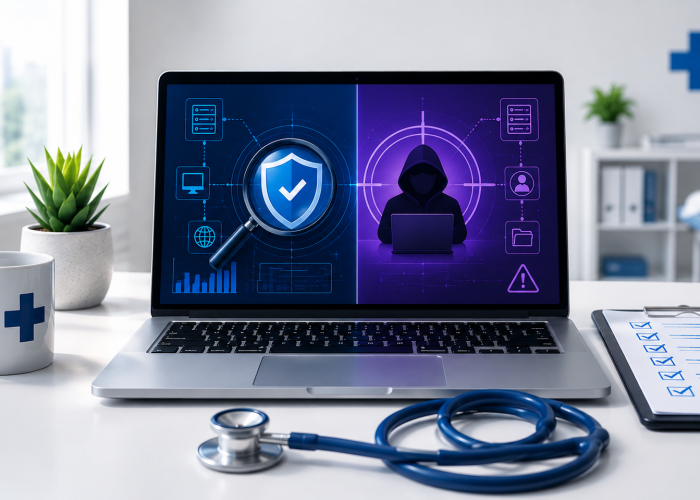
Vulnerability scan vs penetration testing is one of the most commonly misunderstood topics in healthcare cybersecurity. Although these two security assessments are often mentioned together, they serve different purposes in identifying and reducing cyber risk. Understanding how each assessment works helps healthcare organizations better protect patient data, strengthen HIPAA compliance efforts, and improve their overall cybersecurity posture.
Healthcare organizations continue to face increasing pressure from ransomware groups, financially motivated cybercriminals, insider threats, and sophisticated nation-state actors. At the same time, the healthcare technology landscape continues expanding through Electronic Health Records (EHRs), cloud-based applications, patient portals, telehealth platforms, remote work solutions, and third-party vendor integrations. Every new system creates additional opportunities for attackers to identify weaknesses that could compromise sensitive patient information.
Many healthcare leaders assume that vulnerability scanning and penetration testing accomplish the same objective. While both assessments identify cybersecurity weaknesses, they answer two fundamentally different questions. A vulnerability scan identifies what could be vulnerable, while a penetration test determines whether those weaknesses can actually be exploited by an attacker.
Understanding this distinction is essential because cybersecurity is not simply about generating reports—it is about reducing the risks that could disrupt patient care, expose electronic Protected Health Information (ePHI), interrupt billing operations, or result in regulatory consequences.
Why Healthcare Organizations Need Continuous Security Assessments
Healthcare organizations manage some of the most valuable information targeted by cybercriminals. Medical records contain personally identifiable information, insurance details, financial information, prescription histories, laboratory results, diagnoses, and treatment records that often retain long-term value for identity theft and fraud.
Modern healthcare environments are also highly dynamic. New employees are hired, vendors receive remote access, software updates are deployed, cloud applications are introduced, and medical devices are continuously connected to clinical networks. Every operational change creates new opportunities for security weaknesses to emerge.
Without continuous assessment, organizations may unknowingly operate with vulnerabilities that attackers can exploit long before internal IT teams become aware of the problem.
What Is a Vulnerability Scan?
A vulnerability scan is an automated cybersecurity assessment that reviews systems, applications, operating systems, servers, network devices, databases, and web services for known security weaknesses. The scanner compares system configurations against extensive vulnerability databases containing publicly disclosed security flaws and misconfigurations.
Rather than attempting to exploit vulnerabilities, the scanner identifies conditions that could increase cybersecurity risk. These findings help security teams prioritize software updates, improve configurations, and strengthen overall security posture before attackers identify the same weaknesses.
Because vulnerability scanning is automated, organizations can perform assessments regularly with minimal operational disruption.
What Does a Vulnerability Scan Identify?
Healthcare vulnerability scanners typically detect a wide variety of security issues throughout the technology environment.
Common findings include:
- Missing operating system patches
- Outdated software versions
- Unsupported operating systems
- Known software vulnerabilities
- Weak security configurations
- Open network ports
- Misconfigured services
- Exposed internet-facing applications
- Insecure protocols
- Missing security updates
The resulting report often includes severity ratings, affected systems, remediation guidance, and references to publicly known vulnerabilities.
Why Vulnerability Scanning Is Important in Healthcare
Healthcare environments rarely remain static for long. Electronic Health Record systems receive updates, cloud applications introduce new functionality, medical devices are deployed, remote access solutions evolve, and third-party vendors frequently modify integrations.
Routine vulnerability scanning helps organizations identify these changing risks before attackers discover them. Security teams gain continuous visibility into known weaknesses while maintaining better awareness of the organization’s overall cybersecurity posture.
This proactive visibility supports ongoing vulnerability management while reducing the likelihood of preventable security incidents.
The Limitations of Vulnerability Scanning
Although vulnerability scanning provides valuable visibility, it does have important limitations.
A scanner identifies known weaknesses but generally does not determine whether attackers can actually exploit them. It cannot always evaluate how multiple vulnerabilities interact, whether security controls successfully prevent exploitation, or whether compromised systems could ultimately provide access to Electronic Health Records or other sensitive healthcare resources.
In other words, vulnerability scanning identifies possibilities—not proven attack paths.
What Is Penetration Testing?
Penetration testing takes cybersecurity assessment much further. Rather than simply identifying weaknesses, penetration testing safely simulates how real attackers attempt to exploit vulnerabilities within an organization’s environment.
Ethical hackers use many of the same techniques employed by malicious actors while operating within carefully defined rules of engagement. Their objective is to determine whether identified vulnerabilities actually allow unauthorized access to systems, sensitive information, or critical business functions.
The assessment provides practical evidence regarding the organization’s true security posture.
What Does Penetration Testing Evaluate?
Penetration testing evaluates far more than individual software vulnerabilities.
Healthcare penetration testers attempt to answer questions such as:
- Can an exposed web application be exploited?
- Can patient portal vulnerabilities expose Protected Health Information?
- Can a compromised employee account gain administrative privileges?
- Can attackers move laterally through the internal network?
- Can weak segmentation expose billing systems?
- Can Electronic Health Records be accessed?
- Can authentication controls be bypassed?
- Can sensitive healthcare data be reached?
These findings provide leadership with business-focused insight rather than purely technical observations.
Business Risk Versus Technical Findings
One of the greatest differences in the vulnerability scan vs penetration testing discussion involves business context.
A vulnerability scan may report that a server contains a critical software vulnerability with a high severity score. While technically important, this finding alone does not explain the actual organizational impact.
A penetration test may demonstrate that the same vulnerability allows attackers to compromise patient billing systems, access Electronic Health Records, or disable critical clinical applications. This transforms a technical issue into a clearly understood business risk that leadership can prioritize accordingly.
A Simple Analogy
The difference between vulnerability scanning and penetration testing can be understood through a simple building security example.
Imagine hiring an inspector to evaluate a healthcare facility. The inspector identifies unlocked doors, broken locks, open windows, poor lighting, and security cameras that are no longer functioning.
Now imagine hiring a professional security team to determine whether someone can actually enter the building, bypass alarms, access restricted offices, reach patient records, and leave undetected.
The inspection represents vulnerability scanning.
The simulated break-in represents penetration testing.
Both provide valuable information—but they answer different questions.
When Should Healthcare Organizations Perform Vulnerability Scanning?
Vulnerability scanning works best as a continuous operational activity rather than an occasional project.
Healthcare organizations should perform vulnerability scans regularly to support:
- Routine vulnerability management
- Patch management
- Internet-facing asset reviews
- Compliance preparation
- Asset discovery
- Configuration management
- Continuous security monitoring
- Software update verification
Frequent scanning allows organizations to identify newly introduced weaknesses as technology environments evolve.
When Should Healthcare Organizations Perform Penetration Testing?
Penetration testing should occur periodically and whenever significant changes affect the organization’s technology environment.
Healthcare organizations should strongly consider penetration testing after:
- Deploying a new patient portal
- Launching telehealth services
- Implementing Electronic Health Record upgrades
- Migrating systems to cloud infrastructure
- Adding vendor remote access
- Deploying new billing applications
- Introducing new APIs or integrations
- Preparing for cyber insurance renewals
- Completing major network redesigns
Penetration testing also helps validate whether previously identified vulnerabilities have been properly remediated.
Why Healthcare Organizations Need Both
Healthcare cybersecurity cannot rely solely on either assessment.
Vulnerability scanning provides broad, repeatable visibility across the entire technology environment. Organizations quickly identify thousands of known weaknesses that require attention.
Penetration testing provides depth by validating which vulnerabilities represent genuine attack paths capable of compromising patient information, disrupting clinical operations, or exposing critical business systems.
Together, these assessments provide a comprehensive understanding of organizational cybersecurity risk.
Questions Healthcare Leaders Should Ask
Cybersecurity reports should never remain unread after assessments are completed. Executive leadership should actively review findings with IT and cybersecurity teams to understand organizational priorities.
Important questions include:
- Which vulnerabilities present the greatest risk to electronic Protected Health Information?
- Which systems remain exposed to the public internet?
- Which findings could disrupt patient care?
- Which weaknesses repeatedly appear across multiple assessments?
- Who owns remediation activities?
- What deadlines have been established?
- How will successful remediation be validated?
The greatest value comes not from producing reports but from implementing meaningful security improvements.
Vulnerability Management Supports HIPAA Compliance
The HIPAA Security Rule requires covered entities and business associates to conduct accurate and thorough assessments of potential risks affecting the confidentiality, integrity, and availability of electronic Protected Health Information.
While vulnerability scanning and penetration testing alone do not guarantee HIPAA compliance, both support broader security risk management programs by helping organizations identify technical weaknesses, prioritize remediation, document corrective actions, and continuously improve cybersecurity posture.
Organizations that regularly evaluate security demonstrate ongoing due diligence while strengthening their overall compliance efforts.
Final Thoughts: Visibility Plus Validation Creates Stronger Security
Understanding vulnerability scan vs penetration testing allows healthcare organizations to build far more effective cybersecurity programs. Vulnerability scanning provides continuous visibility into known weaknesses, while penetration testing validates whether those weaknesses create realistic attack opportunities.
Neither assessment replaces the other because each provides unique insight into organizational cybersecurity risk. Together, they help healthcare leaders make informed decisions that protect patient information, strengthen HIPAA compliance, improve operational resilience, and reduce the likelihood of costly cybersecurity incidents.
Healthcare cybersecurity is no longer simply about finding vulnerabilities. It is about understanding which vulnerabilities matter most and fixing them before attackers have the opportunity to exploit them.
Continue Learning with Tempest Healthcare IT
Cyber threats continue evolving, making continuous education an essential part of healthcare cybersecurity. At Tempest Healthcare IT, we regularly publish practical security guidance, HIPAA compliance resources, penetration testing best practices, vulnerability management strategies, and educational articles designed specifically for healthcare organizations.
Follow Tempest Healthcare IT on LinkedIn to stay informed about emerging healthcare cyber threats, cybersecurity best practices, and practical strategies that help protect patient data while strengthening organizational resilience.
LinkedIn: https://www.linkedin.com/company/tempesthealthcareit