
Healthcare Ransomware Defense: Making Cyberattacks More Expensive and Less Profitable
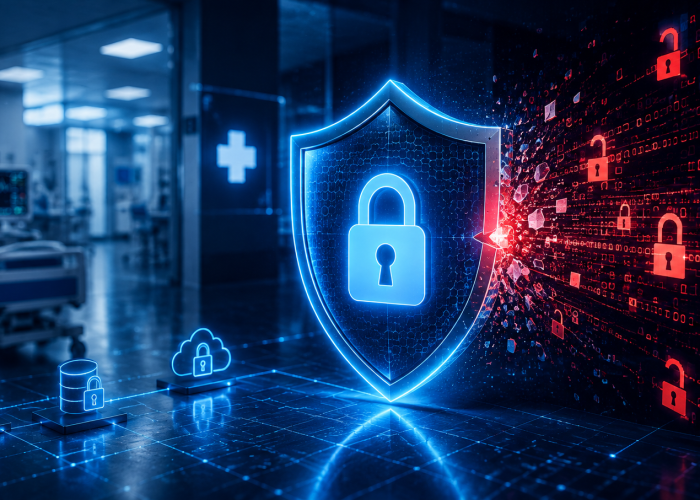
Healthcare ransomware defense must address more than the malicious software deployed at the end of an attack. Modern ransomware operations function like businesses, with attackers investing in infrastructure, stolen credentials, malware development, affiliates, and access brokers because they expect a financial return. Healthcare organizations become attractive targets when attackers believe operational disruption will create enough pressure to make extortion profitable.
This economic reality changes how healthcare organizations should approach healthcare ransomware defense. The goal is not simply to block one malicious file or stop one phishing email. A stronger strategy raises the attacker’s cost at every stage, making the organization harder to enter, harder to navigate, harder to disrupt, and easier to recover.
The most useful question is therefore not, “Can we prevent every ransomware attempt?” A better question is, “How many independent barriers must an attacker overcome before reaching patient data, backup systems, or critical clinical operations?” The more barriers an attacker encounters, the less attractive the organization becomes as a target.
Ransomware Is an Economic Model
Ransomware groups often operate with clear financial incentives. They spend money and time acquiring infrastructure, purchasing stolen access, developing malware, recruiting affiliates, and maintaining extortion operations. Every attack must therefore generate enough potential return to justify those costs.
Healthcare can appear profitable because downtime affects more than productivity. Disruptions may interfere with Electronic Health Records (EHRs), diagnostic services, scheduling, pharmacy workflows, claims processing, billing, and patient communication. Attackers understand that this operational pressure can create leverage.
The defensive objective should be to reduce that leverage while increasing the resources an attacker must spend. If one compromised password provides access to the entire environment, the attack is inexpensive. If the attacker must defeat MFA, bypass device controls, cross segmented networks, obtain temporary privileged access, and defeat monitored backups, the economics change significantly.
Attackers Search for the Cheapest Way Inside
Not every ransomware campaign begins with a sophisticated zero-day vulnerability. Many attacks start with weaknesses that are cheaper and easier to exploit, such as outdated internet-facing applications, stolen passwords, exposed remote-access services, phishing, or poorly controlled vendor access. Attackers naturally prefer paths that require the least effort.
Common ransomware entry points include:
- Exposed internet-facing services
- Unpatched vulnerabilities
- Compromised employee credentials
- Phishing and social engineering
- VPN and remote-access systems
- Third-party vendor connections
- Earlier malware or infostealer infections
Some cybercriminals do not perform the initial intrusion themselves. Initial access brokers may compromise organizations and sell working credentials or network access to ransomware groups. This criminal specialization makes preventing inexpensive entry points even more important.
Remove Unnecessary Internet Exposure
Every internet-facing system increases the number of places an attacker can look for weaknesses. Healthcare organizations should maintain an accurate inventory of public-facing applications, VPN appliances, remote-support tools, patient portals, firewalls, cloud services, and administrative interfaces. Anything that does not require direct internet exposure should be removed or restricted.
A forgotten server can become one of the cheapest attack paths in the entire environment. Systems may remain online after migrations, vendor projects, testing activities, or infrastructure changes because no one realizes they are still publicly reachable. Continuous attack-surface monitoring helps identify these forgotten assets before attackers do.
Internet-facing vulnerabilities should also receive faster remediation than ordinary internal findings. When a vulnerability has known exploitation activity, public exploit code, or affects a system providing remote access, the remediation priority should increase substantially. Risk-based patching is more useful than treating every vulnerability as equally urgent.
Make Stolen Passwords Less Valuable
Credential theft remains one of the most efficient ways for attackers to enter healthcare systems. Passwords can be captured through phishing, infostealer malware, credential stuffing, password reuse, and third-party breaches. The defensive objective should be to ensure that possession of a password does not automatically provide meaningful access.
Multi-factor authentication reduces the usefulness of stolen credentials, particularly when phishing-resistant authentication is used for email, remote access, cloud administration, and privileged identities. Organizations should also disable inactive accounts and regularly review whether users still require the access they have accumulated over time. Identity hygiene removes unnecessary pathways attackers might otherwise exploit.
Healthcare organizations should strengthen identity security by:
- Disabling inactive and orphaned accounts
- Removing excessive permissions
- Separating administrator and everyday user identities
- Restricting unmanaged devices
- Monitoring unusual authentication activity
- Requiring stronger verification for sensitive actions
A stolen credential should generate friction and investigation rather than unrestricted access to healthcare systems.
Stop Attackers From Moving Freely
Initial compromise is often only the first stage of ransomware. After obtaining access, attackers typically explore the environment, collect credentials, discover servers, locate backup infrastructure, and identify systems that would create the greatest operational impact. Flat networks significantly lower the effort required to perform this lateral movement.
Network segmentation increases attacker cost by creating controlled boundaries between different parts of the environment. A compromised workstation should not automatically be able to reach EHR servers, medical devices, identity platforms, or backup systems. Each boundary forces the attacker to find another weakness.
Important healthcare environments that may require separation include:
- EHR infrastructure
- Backup and recovery systems
- Identity platforms
- Connected medical-device networks
- Billing and revenue cycle systems
- Vendor connections
- Privileged administrative environments
- Guest and general employee networks
Segmentation must also be validated rather than assumed. A network diagram showing separate zones does not prove that traffic is actually restricted. Penetration testing and firewall-rule reviews can determine whether those boundaries hold under realistic attack conditions.
Replace Standing Administrator Rights With Temporary Access
Administrative accounts are highly valuable because they allow attackers to modify security controls, create additional accounts, access sensitive resources, and interfere with recovery. Standing administrative privileges reduce the work required to escalate an intrusion. Attackers benefit whenever powerful credentials are always available.
Healthcare organizations should consider just-in-time privileged access wherever practical. Under this model, administrative rights are activated only for an approved task and automatically removed after the authorized period ends. This reduces the amount of permanent privilege available for attackers to steal or misuse.
Privileged activities should also require strong authentication, approved devices, detailed logging, and monitoring. Administrative identities should remain separate from ordinary email and browsing accounts. These controls force attackers to overcome multiple obstacles before reaching the permissions necessary for large-scale ransomware deployment.
Make Data Theft Difficult to Hide
Modern ransomware increasingly involves data theft before encryption. Attackers may copy patient information, financial records, internal communications, or other sensitive data and then threaten publication if the organization refuses to pay. This “double extortion” model gives criminals leverage even when backups allow systems to be restored.
Healthcare organizations should monitor behavior that may indicate large-scale collection or exfiltration. Unusual downloads, unexpected archive creation, large outbound transfers, and access to patient populations unrelated to a user’s normal responsibilities should receive attention. Abnormal activity involving service accounts and vendors can also reveal compromise.
Useful detection signals include:
- Large or unusual data downloads
- Unexpected outbound data transfers
- Sudden archive or compression activity
- Access to unrelated patient records
- Connections to unfamiliar cloud-storage platforms
- Abnormal service-account behavior
- Unusual vendor access
- Unexpected administrative-tool usage
Centralized logging, endpoint detection and response, identity monitoring, and network visibility make prolonged attacker activity harder to conceal.
Reduce the Attacker’s Leverage With Recoverable Backups
Ransomware gains much of its power from operational urgency. If critical systems are encrypted and the organization cannot restore them, attackers gain tremendous leverage. Reliable recovery capabilities directly weaken the ransomware business model.
Healthcare organizations should maintain protected copies of essential information and configurations, including offline or immutable backups where appropriate. Backup administration should use separate credentials so compromising the primary environment does not automatically expose recovery systems. Access to backup management should also require strong authentication and monitoring.
Most importantly, restoration must be tested. A successful backup notification only proves that data was written somewhere; it does not prove the organization can restore critical applications under pressure. Regular recovery exercises transform backups from assumptions into demonstrated capabilities.
Eliminate Third-Party Shortcuts
Healthcare organizations rely heavily on vendors for EHR platforms, medical devices, billing applications, cloud services, and technical support. These relationships often require remote access to sensitive environments. Attackers may therefore target vendors when direct compromise of the healthcare organization appears more difficult.
Third-party access should never mean permanent trust. Every vendor account should have a clear owner, purpose, and authorized timeframe. Access should also be limited to the minimum systems required to perform the contracted task.
Third-party access should be:
- Individually assigned rather than shared
- Protected with multi-factor authentication
- Restricted to necessary systems
- Activated only when needed
- Logged and monitored
- Reviewed regularly
- Disabled when support ends
Temporary vendor access should expire automatically whenever possible. A forgotten support account can become a long-term shortcut that bypasses stronger controls elsewhere in the environment.
What Layered Ransomware Defense Looks Like
Consider a medical practice with an internet-facing remote-access service protected only by a password. An attacker obtains an employee’s credentials, signs in, discovers that servers and workstations share the same network, and finds that the employee already has local administrative privileges. Backup credentials are stored on an accessible server.
In that environment, a single stolen password may quickly lead to privileged access, backup compromise, data theft, and ransomware deployment. The attacker encounters very little resistance between initial access and organization-wide disruption. From a criminal economics perspective, this is an inexpensive attack path.
Now consider the same credential theft in a stronger environment. Remote access requires phishing-resistant MFA and an approved device, administrator accounts are separate and normally inactive, segmentation restricts access to critical servers, backup credentials are isolated, and unusual transfers generate alerts. Tested offline or immutable recovery options are also available.
The original credential theft still matters, but it no longer produces an inexpensive route to catastrophic impact. The attacker must defeat several independent controls, increasing time, complexity, detection risk, and cost. That is exactly what a ransomware defense strategy should accomplish.
Validate Whether Defenses Actually Work
Healthcare organizations frequently have security policies and technology that appear effective on paper. The real question is whether those controls withstand the attack techniques ransomware operators actually use. Independent validation converts cybersecurity assumptions into evidence.
Vulnerability assessments identify missing patches, exposed services, insecure configurations, unsupported systems, and known vulnerabilities. Penetration testing goes further by determining whether those findings can be combined into meaningful attack paths. The difference is especially valuable when leadership needs to understand practical business risk.
Testing should examine whether an attacker can:
- Bypass or weaken MFA
- Escalate from a standard user account
- Move between segmented networks
- Reach backup infrastructure
- Exploit vendor access
- Disable security monitoring
- Access unnecessary volumes of PHI
- Maintain persistence after an account is disabled
Testing in healthcare should always be authorized, carefully scoped, and planned around clinical operations. The objective is to identify vulnerabilities without introducing unnecessary risk to patient care.
Final Thoughts
Healthcare ransomware defense is most effective when it recognizes ransomware as a criminal business model built around finding vulnerable organizations where disruption can generate financial leverage. Healthcare cybersecurity should respond by changing those economics through multiple independent barriers, rapid detection, protected recovery capabilities, and continuous validation. The harder an organization is to enter, navigate, exploit, and disrupt, the less predictable the criminal return becomes.
Ransomware groups may continue investing in new techniques, but healthcare organizations can make those investments less effective by eliminating easy access and reducing the impact of compromise. A mature healthcare ransomware defense strategy assumes some controls may eventually fail and ensures that attackers still encounter additional obstacles before reaching patient data or critical operations. For more practical guidance on healthcare ransomware defense, HIPAA cybersecurity, penetration testing, vulnerability management, and cyber resilience, follow Tempest Healthcare IT on LinkedIn: https://www.linkedin.com/company/tempesthealthcareit/