
Beyond Delete: Why Verifiable Data Destruction in Healthcare Matters
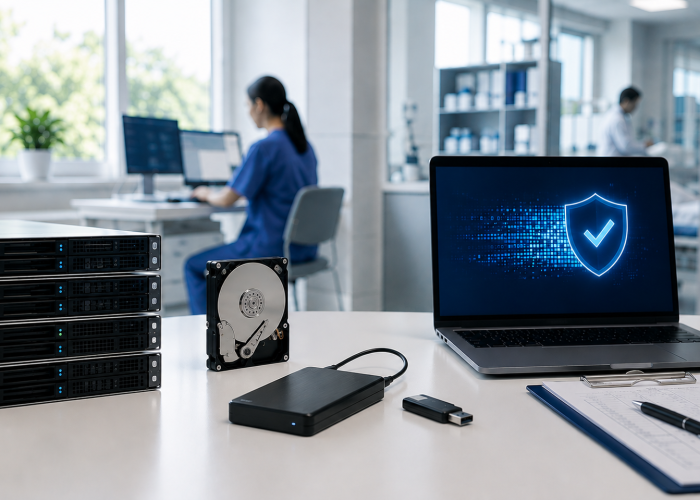
Verifiable data destruction in healthcare addresses a deceptively simple question: when an organization deletes patient information, can it prove that the information is actually unrecoverable? Healthcare organizations across the United States accumulate enormous volumes of information across EHR platforms, billing applications, cloud environments, patient portals, backups, analytics systems, employee devices, and third-party services. Eventually, portions of that information reach the end of their required lifecycle.
A server may be retired, a cloud contract terminated, an application replaced, or a medical practice acquired by another organization. Employees may click Delete, administrators may close an account, or a vendor may confirm that old information has been removed. Those actions can end normal access to data without necessarily proving that every underlying copy has been securely addressed.
For healthcare leaders, secure destruction should therefore be considered part of patient-data protection rather than routine IT housekeeping. Information requires safeguards throughout its lifecycle, including when an organization no longer needs to retain it. Data that has disappeared from an application interface may still exist somewhere else.
Deletion Is Not the Same as Data Sanitization
Deleting a file commonly removes the user’s normal method of locating or accessing it. Depending on the underlying technology, the actual information may remain recoverable from storage until it is overwritten, sanitized, cryptographically rendered inaccessible, or the media itself is destroyed. Healthcare organizations should therefore distinguish logical deletion from secure sanitization.
Sensitive healthcare information can also exist in more locations than the primary application. Copies may remain in system backups, cloud snapshots, replicated databases, exported reports, test environments, employee downloads, vendor systems, retired hardware, or disaster-recovery environments. Deleting the primary record does not necessarily address these secondary copies.
NIST describes media sanitization as a process that makes access to target data infeasible for a defined level of effort. Its guidance organizes sanitization around three broad methods: clear, purge, and destroy. Selecting the appropriate approach depends on factors including the sensitivity of the information, storage technology, organizational requirements, and whether the media will be reused.
Clear, Purge, and Destroy Serve Different Purposes
Clear generally applies logical techniques to sanitize data while allowing the storage media to remain usable. It can be appropriate when the organization has determined that the selected technique provides adequate protection for the information and reuse scenario. The objective is more deliberate than simply deleting a file through the operating system or application.
Purge provides a stronger level of sanitization intended to make recovery infeasible even when more advanced recovery techniques are considered. Depending on the storage technology, an appropriate purge technique may include cryptographic erase or other technology-specific sanitization methods. This approach can be particularly useful when organizations intend to reuse or repurpose storage.
Destroy physically renders media unusable for continued storage. Physical destruction may be appropriate for certain retired devices, damaged media, or circumstances where reuse is unnecessary and the sensitivity of the information warrants it. Healthcare organizations should establish which method applies before equipment or storage reaches the end of its lifecycle.
The Healthcare Data Lifecycle Does Not End With Migration
Consider a physician practice moving from one cloud-based billing application to another. Active patient and claims information is successfully exported, user accounts on the old system are disabled, and the organization terminates its contract. Operationally, the migration may appear complete.
The cybersecurity and privacy questions continue after the final login. Historical databases, temporary migration files, vendor backups, support logs, disaster-recovery replicas, testing environments, and information held by subcontractors may still exist. Each copy can have a different lifecycle and destruction process.
This illustrates why verifiable data destruction in healthcare requires both technical and contractual controls. The healthcare organization needs to understand what the vendor retains, why it remains, how long it will remain, and how it will eventually be disposed of. Closing an account does not provide those answers by itself.
Business Associate Offboarding Deserves Attention
Healthcare organizations routinely provide PHI to business associates that perform services on their behalf. When one of those relationships ends, data disposition should be addressed as part of vendor offboarding rather than treated as an administrative afterthought. The organization’s contract and business associate agreement should establish responsibilities before the relationship reaches that point.
HIPAA business associate requirements generally call for the return or destruction of PHI at termination where feasible. When return or destruction is not feasible, protections must continue and further uses and disclosures remain limited to the purposes making return or destruction infeasible. This makes end-of-contract data handling an important component of healthcare vendor risk management.
A contractual promise is valuable, but it does not automatically explain the technical process behind destruction. Healthcare organizations should understand what systems are covered, whether replicas and backups are addressed, which subcontractors possess copies, and what evidence will demonstrate completion. Vendor accountability becomes stronger when these expectations are established before data is transferred.
Why Backups Complicate Data Destruction
Backups create one of the more challenging aspects of healthcare data lifecycle management. Healthcare organizations need reliable backups for availability, business continuity, ransomware recovery, and disaster recovery. Those same copies can complicate efforts to establish that information has reached the end of its lifecycle.
Organizations should understand whether deleted information remains inside immutable backups, historical snapshots, offline archives, or replicated recovery environments. Policies should define what happens when those backup sets naturally expire and how restored historical backups are handled. Restoring an old backup should not unintentionally reintroduce information that had previously reached an approved disposition point without appropriate controls.
This does not mean healthcare organizations should recklessly modify protected backups simply to remove individual records. Retention, availability, legal, compliance, and security requirements need to be evaluated together. A defensible process explains what remains, why it remains, how it is protected, and when it will ultimately become eligible for destruction.
Cryptographic Erase Can Provide Another Option
One important sanitization technique is cryptographic erase. Instead of physically destroying every storage device or individually overwriting every piece of information, cryptographic erase relies on securely sanitizing the cryptographic keys necessary to decrypt properly encrypted data. Without the required keys, recovery of the underlying plaintext is intended to become infeasible.
This approach can be particularly useful in cloud and large-scale storage environments where individual physical media may not be accessible to the healthcare customer. Modern systems can distribute information across storage infrastructure that customers neither own nor physically control. Encryption and disciplined key management can therefore become important parts of lifecycle planning.
Cryptographic erase is not simply a matter of deleting any available encryption key. The organization needs confidence that the target data was actually protected by that key, that unencrypted copies do not remain, and that duplicate or backup keys have also been addressed. The destruction process must also be authorized, completed correctly, and capable of validation.
Cryptographic Erase Requires Good Key Management
Encryption architecture should be designed with the entire information lifecycle in mind. Security teams need to understand which keys protect which datasets, where those keys are stored, whether copies exist, and who has authority to revoke or destroy them. Poor key inventory can undermine an otherwise sophisticated cryptographic erase process.
Organizations also need safeguards against premature destruction. Eliminating the only usable encryption key for information that must still be retained can transform a security control into an availability, legal, or compliance problem. Data eligibility should therefore be confirmed before irreversible sanitization occurs.
Authorization should involve appropriate technical and business stakeholders. Sensitive healthcare information may be subject to medical-record retention requirements, contractual obligations, litigation holds, or other legal considerations. Destruction should be intentional, governed, and documented rather than triggered simply because storage is inconvenient.
Know Where Sensitive Healthcare Data Exists
Healthcare organizations cannot securely destroy information they do not know they possess. Data inventories should therefore extend beyond production EHRs and include billing systems, cloud storage, patient portals, archives, backups, employee devices, test environments, analytics tools, vendor applications, and disaster-recovery systems. Shadow copies and forgotten exports can create particularly difficult disposal problems.
Data mapping can help organizations understand how PHI moves between systems. A patient record may originate in an EHR, pass through an interface engine, enter a billing platform, appear in an analytics environment, and eventually reach an external vendor. Each location may have its own retention and deletion behavior.
The inventory should also evolve as the environment changes. New applications, integrations, vendors, cloud services, and acquisitions can create additional copies of sensitive information. Data lifecycle governance works best when discovery occurs continuously rather than only during system retirement.
Establish a Defensible Healthcare Retention Schedule
Healthcare organizations should determine how long information needs to be retained before deciding how it will be destroyed. Importantly, the HIPAA Privacy Rule itself does not establish medical-record retention periods. State laws and other applicable requirements can determine how long specific healthcare records must remain available.
Retention decisions should therefore involve more than the cybersecurity department. Legal, compliance, privacy, clinical, health information management, and records-management personnel may all have relevant requirements. Different categories of information can require different retention periods.
The resulting schedule should identify what information is retained, why it is retained, how long it remains, and what happens when that period ends. Without this governance, organizations can fall into two problematic extremes: destroying information too early or retaining everything indefinitely. Both can create unnecessary organizational risk.
Match the Destruction Method to the Risk
Not every storage technology requires the same sanitization technique. A retired physical drive, cloud storage volume, encrypted mobile device, backup archive, and virtual machine snapshot can require different approaches. The organization’s destruction standard should therefore account for both the information sensitivity and the technology involved.
HIPAA’s Security Rule requires policies and procedures addressing the final disposition of ePHI and the hardware or electronic media on which it is stored. It also addresses removing ePHI from electronic media before that media is made available for reuse. These requirements reinforce the need for a defined process rather than informal deletion.
Organizations should document which sanitization methods are acceptable for different technologies and risk levels. Those standards can then guide IT teams, cloud administrators, vendors, and disposal providers. Consistency becomes especially valuable when hundreds or thousands of devices and datasets move through lifecycle changes.
Strengthen Cloud and Vendor Contracts
Cloud computing makes data destruction more dependent on third parties. A healthcare customer may have no physical access to the servers containing its information and may not know exactly which storage device holds a particular record. Contractual and technical transparency therefore become important.
Agreements should address:
- Data return requirements
- Secure destruction methods
- Backup and replica handling
- Subcontractor responsibilities
- Destruction timelines
- Verification or certification
- Exceptions required by law
- Continued safeguards when destruction is not feasible
Healthcare organizations should understand these provisions before adopting a service rather than discovering limitations during contract termination. Exit planning belongs in vendor selection because the organization’s ability to recover or destroy information later can depend on decisions made at the beginning of the relationship.
Preserve Evidence of Data Destruction
The word verifiable is what separates a mature destruction program from a simple deletion process. Healthcare organizations should retain evidence showing what was destroyed, when destruction occurred, which method was used, who authorized it, which systems were included, and how completion was validated. Documentation creates accountability and supports later review.
For physical media, evidence may include inventory records, chain-of-custody documentation, destruction records, or certificates from qualified providers. For cloud systems, evidence may depend on vendor attestations, platform logs, account records, key-management events, or contractual certifications. The appropriate evidence depends on the technology and destruction method.
A generic statement that “the data was deleted” provides limited assurance. A stronger record connects a defined dataset or asset to an approved retention decision, documented sanitization technique, responsible parties, and validation result. That difference can matter during security assessments, vendor reviews, investigations, and audits.
Validation Is Different From Verification
A mature sanitization process should consider whether the selected technique was performed correctly and whether the intended outcome was achieved. Simply issuing a destruction command does not necessarily demonstrate successful completion. Organizations need a way to identify failures, exceptions, and incomplete actions.
Technical validation may involve reviewing system results, sanitization logs, key-management records, device status, or other evidence appropriate to the technology. Physical destruction processes may require different forms of inspection and chain-of-custody documentation. Vendor-managed environments may depend more heavily on contractual evidence and independent assurance.
Healthcare organizations should establish these expectations before destruction occurs. If nobody knows what evidence is required until after the system has been decommissioned, obtaining reliable proof can become much more difficult. Verification should therefore be designed into the process.
Test Application and Vendor Offboarding
Healthcare organizations frequently test backups and incident-response plans, but vendor offboarding can receive less attention. The first time an organization discovers how difficult it is to retrieve and destroy its data should not be after a critical vendor relationship ends. Exit procedures should be understood before they are urgently needed.
An offboarding test should evaluate data exports, administrative accounts, API credentials, integrations, remote access, storage locations, backups, and contractual destruction procedures. Security teams should also verify that former vendor connections and obsolete accounts are no longer accessible. These checks can expose dependencies that were not apparent during normal operations.
Acquisitions deserve similar attention. When one medical practice acquires another, both organizations may inherit applications, archives, devices, vendors, and historical data that require different retention treatment. Consolidating systems without understanding these legacy repositories can create long-term data exposure.
Include Retired Devices in the Process
Healthcare facilities continually retire laptops, workstations, servers, mobile devices, removable media, and specialized equipment. Some of these assets may contain locally stored PHI, cached credentials, exported reports, diagnostic information, or configuration data. Equipment leaving organizational control should therefore follow an approved sanitization process.
This is particularly important when devices are resold, returned to a leasing company, transferred to another department, donated, or recycled. Reuse creates a different risk profile from physical destruction because the media remains operational. The sanitization method should account for the device technology and intended destination.
Asset inventories and disposal records should connect these lifecycle events. Security teams should be able to determine which asset was retired, what information it could contain, how it was sanitized, and where it went afterward. This creates a defensible chain from active use through final disposition.
Final Thoughts
Verifiable data destruction in healthcare means going beyond clicking Delete and assuming information has disappeared. Healthcare organizations need to know where sensitive information exists, retain it for the appropriate period, select suitable sanitization methods, manage encryption keys carefully, hold vendors accountable, and preserve evidence that approved destruction actually occurred. Data that is no longer visible can still present risk if it remains recoverable somewhere else.
Patient information that the organization no longer needs can still be valuable to an attacker. Building destruction into the healthcare data lifecycle helps reduce unnecessary exposure while supporting stronger privacy, cybersecurity, and risk-management practices. For practical guidance on healthcare cybersecurity, HIPAA security, cloud risk, vulnerability management, patient data protection, and cyber resilience, follow Tempest Healthcare IT on LinkedIn: https://www.linkedin.com/company/tempesthealthcareit/