
AI Deepfakes in Healthcare: How Healthcare Organizations Can Defend Against AI-Powered Impersonation Attacks
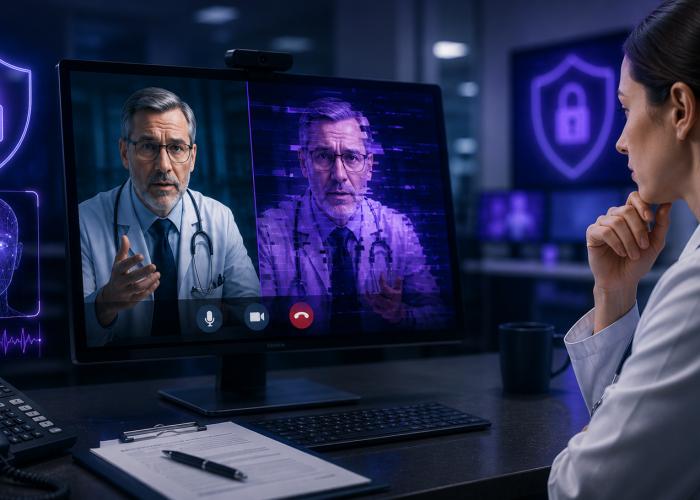
AI-powered social engineering campaigns, along with voice cloning, AI-generated video, and realistic phishing emails, are making it increasingly difficult to determine whether a request is legitimate. For healthcare organizations, this emerging threat is more than a cybersecurity challenge—it is a patient safety, compliance, operational continuity, and business risk issue.
The Rise of AI-Powered Social Engineering
Cybercriminals have always relied on social engineering to manipulate people into revealing information, transferring money, or granting access. Traditional attacks often depended on phishing emails, fake websites, or phone scams that contained obvious warning signs. Employees could often identify suspicious activity by spotting poor grammar, unusual requests, or inconsistent communication.
Artificial intelligence has dramatically changed that landscape. Attackers can now generate realistic emails, clone voices, create convincing video calls, and automate personalized attacks at scale. These tools allow threat actors to exploit trust more effectively than ever before.
The FBI has warned that cybercriminals are actively using AI-generated content to conduct increasingly sophisticated phishing and impersonation attacks. Voice cloning and deepfake video technology now allow attackers to convincingly imitate executives, employees, vendors, and other trusted individuals. The result is a new generation of cyber threats that target human decision-making rather than technical vulnerabilities.
Why Healthcare Organizations Are Prime Targets
Healthcare organizations present an attractive target for AI-powered impersonation attacks because many critical workflows depend on urgency. Healthcare employees routinely make rapid decisions involving patient care coordination, revenue cycle management, vendor payments, IT support requests, and privileged account access. In many situations, delays can directly affect patient care, operational efficiency, or financial performance.
Attackers understand this dynamic. The faster an organization moves, the more likely employees are to act before thoroughly verifying a request. This creates opportunities for social engineering attacks that exploit urgency, authority, and trust.
Healthcare also manages vast amounts of sensitive information, including patient records, financial data, intellectual property, and operational systems. These assets make healthcare organizations especially attractive targets for financially motivated cybercriminals and nation-state actors alike.
How Deepfake Attacks Work
Deepfake attacks leverage artificial intelligence to generate convincing audio, video, or text that appears to come from a trusted source. Unlike traditional phishing attacks, deepfakes can create highly realistic impersonations that may fool even experienced employees. The technology continues to improve, making detection increasingly difficult.
An attacker may clone the voice of a physician requesting urgent access to patient records. They may generate a video call that appears to include a healthcare executive authorizing a financial transaction. They may also create realistic emails that perfectly mimic internal communication styles and branding.
The objective remains the same: convince someone to take an action they would not normally take. Whether the goal is obtaining credentials, transferring funds, bypassing security controls, or accessing sensitive data, the attack relies on exploiting trust rather than technology.
Real-World Healthcare Threats
Healthcare organizations are already encountering increasingly sophisticated social engineering campaigns. In 2024, the U.S. Department of Health and Human Services Health Sector Cybersecurity Coordination Center (HC3) warned healthcare organizations about advanced attacks targeting IT help desks. These incidents demonstrated how effective impersonation can be when attackers gather sufficient personal information.
According to the alert, attackers impersonated employees in financial and administrative roles. Using personal details likely obtained through previous data breaches or public sources, they contacted help desk personnel and claimed they could not access multi-factor authentication because their phone was broken. The attackers then convinced support staff to register a new MFA device under their control.
Once access was established, the threat actors targeted payer portals, payment systems, and financial workflows. Notably, the attack did not rely on malware or technical exploits. Instead, it relied entirely on manipulating trust and exploiting weaknesses in identity verification procedures.
The Scattered Spider Example
One of the most well-known threat groups associated with advanced social engineering is Scattered Spider. This financially motivated threat actor has targeted organizations across multiple industries, including healthcare. Security researchers and government agencies have repeatedly warned about the group’s sophisticated tactics.
Reports indicate that Scattered Spider uses advanced voice phishing techniques and, in some cases, AI-generated voice spoofing to gain initial access. Rather than attacking technical systems directly, they focus on manipulating employees through convincing conversations and impersonation tactics. This approach often allows them to bypass traditional security controls.
The effectiveness of these attacks highlights why identity verification procedures are becoming increasingly important. Organizations can no longer assume that a familiar voice or convincing story is enough to establish trust.
The Arup Deepfake Fraud Case
One of the most striking examples of AI-powered deception occurred in 2024 when engineering firm Arup disclosed a major deepfake fraud incident. According to public reports, an employee participated in what appeared to be a legitimate video conference involving senior company executives. Everything about the meeting appeared authentic.
The individuals on the call looked real, their voices sounded genuine, and the conversation appeared legitimate. Unfortunately, the participants were AI-generated impersonations. The employee was ultimately convinced to transfer approximately HK$200 million to attacker-controlled accounts.
Importantly, Arup stated that its internal systems were never compromised. The attackers did not deploy ransomware, exploit software vulnerabilities, or infiltrate the network. Instead, they targeted the business process itself, proving that not every cyberattack begins with malware.
How Deepfakes Could Impact Healthcare
Healthcare organizations face unique risks when it comes to AI impersonation attacks. A successful deepfake attack could be used to approve fraudulent vendor banking changes, reset privileged user accounts, bypass MFA enrollment controls, or transfer sensitive patient information. The potential consequences extend far beyond financial losses.
Attackers may also attempt to authorize large financial transactions, modify payer information, release operational data, or request emergency access to critical systems. Because healthcare operations often involve urgent decision-making, employees may feel pressured to act quickly without verifying requests.
The combination of urgency and trust creates a powerful attack vector. Cybercriminals understand that healthcare teams are trained to respond quickly, making them particularly susceptible to carefully crafted impersonation attempts.
HIPAA and AI Impersonation Risks
The HIPAA Security Rule requires covered entities and business associates to implement reasonable and appropriate safeguards to protect electronic Protected Health Information (ePHI). This includes protecting against reasonably anticipated threats and impermissible disclosures. As AI-driven social engineering becomes more common, organizations must consider these threats as part of their risk management strategy.
If a deepfake attack results in unauthorized access to patient data, the consequences may include HIPAA violations, regulatory investigations, breach notification requirements, and significant financial penalties. The reputational impact can also be substantial.
Protecting against AI impersonation attacks is increasingly becoming both a cybersecurity issue and a compliance issue. Organizations that fail to adapt may face heightened regulatory and operational risks.
The New Rule: Verify the Process, Not the Person
One of the most important lessons healthcare organizations must learn is that trust can no longer be based solely on voice, appearance, or familiarity. A recognizable voice is not proof of identity. A convincing video call is not proof of identity.
An executive title, email signature, or urgent request should never be the sole factor used to authorize sensitive actions. Organizations must shift from verifying people to verifying processes. Security controls should remain in place regardless of who appears to be making the request.
This mindset helps ensure that attackers cannot bypass security simply by impersonating someone in authority. Verification must become a standard part of every high-risk workflow.
Multi-Channel Verification Is Essential
High-risk requests should always be independently verified. Organizations should establish procedures requiring employees to confirm requests using trusted channels rather than relying on information provided by the requester. This simple practice can prevent many impersonation-based attacks.
For example, if a physician requests access changes by phone, staff should independently verify the request using a number listed in the organization’s directory. If a finance executive requests a vendor banking change, the request should be validated through established internal procedures.
Verification should occur outside the original communication channel whenever possible. This creates an additional layer of protection against social engineering attacks.
Practical Defenses Against AI Impersonation
Healthcare organizations can significantly reduce risk by implementing several practical safeguards. One of the most effective measures is requiring independent callback verification for sensitive requests. Employees should never rely solely on phone numbers or contact information provided during the request itself.
Organizations should also implement dual approval processes for critical actions such as vendor banking changes, MFA resets, privileged account modifications, patient data exports, and financial transactions. Requiring multiple authorized approvals reduces the likelihood that a single employee can be manipulated into authorizing fraudulent activity.
Help desks should strengthen identity verification procedures for account recovery, password resets, and MFA enrollment requests. Additional safeguards such as supervisor approval, callbacks to verified numbers, and enhanced identity checks can significantly reduce risk.
Healthcare organizations should also move beyond SMS-based MFA whenever possible. Stronger authentication methods such as FIDO2 security keys, conditional access policies, trusted device verification, and hardware-based authentication provide better protection against social engineering and credential theft.
Train Employees on AI-Powered Social Engineering
Security awareness training must evolve alongside emerging threats. Employees should learn to recognize common manipulation tactics such as urgency, secrecy, requests to bypass policy, new contact numbers, unexpected communication platforms, and requests for MFA codes. Awareness remains one of the strongest defenses against social engineering.
Training should also address common excuses used by attackers, such as claims of broken devices or emergency situations. Employees must understand that security procedures exist for a reason and should not be bypassed simply because someone appears trustworthy.
Regular training reinforces good habits and helps employees identify warning signs before an incident occurs. The more familiar staff become with these tactics, the more likely they are to pause and verify suspicious requests.
Practice Deepfake Response Scenarios
Preparation is critical. The FBI, CISA, and NSA recommend that organizations conduct tabletop exercises involving AI impersonation scenarios. These exercises help employees practice responding to realistic attack situations in a controlled environment.
Healthcare organizations should simulate executive impersonation attempts, help desk fraud scenarios, vendor payment scams, account takeover attempts, and emergency access requests. Practicing these situations improves decision-making and strengthens organizational resilience.
The goal is not only to test security controls but also to build confidence among employees. When staff know how to respond, they are less likely to be manipulated during a real incident.
Building a Culture of Verification
Technology alone cannot solve the deepfake problem. Organizations must build a culture where verification is viewed as a normal part of operations rather than an obstacle. Employees should feel empowered to question unusual requests, regardless of who appears to be making them.
Verification should never be interpreted as distrust. Instead, it should be viewed as responsible risk management and a critical component of protecting patient information and organizational assets.
The organizations most resilient to AI-powered attacks will be those that normalize verification throughout their culture. In the age of deepfakes, trust must be supported by process, not assumption.
The Tempest Healthcare IT Perspective
Artificial intelligence is transforming both cybersecurity defenses and cyber threats. As attackers become more effective at imitating trusted individuals, healthcare organizations must strengthen the processes that govern access, approvals, and decision-making.
The goal is not to create unnecessary friction. The goal is to ensure that urgent requests involving money, patient information, privileged access, or operational continuity are handled safely and consistently.
At Tempest Healthcare IT, we help healthcare organizations strengthen identity security, improve verification procedures, implement Zero Trust principles, and develop resilient workflows that reduce the risk of AI-powered social engineering attacks.
Protecting Trust in the Age of AI
Trust remains essential in healthcare. Patient care depends on communication, collaboration, and rapid decision-making. However, trust alone can no longer serve as a security control.
As AI-generated voices, videos, and messages become increasingly convincing, healthcare organizations must adapt. A strong AI impersonation defense begins with a simple principle:
No single call, voice, message, email, or video should ever be able to override established security controls.
The future of healthcare cybersecurity will depend not only on protecting systems and data, but also on protecting the trust that keeps healthcare organizations running. In the era of AI-driven deception, verification is no longer optional—it is essential.
About Tempest Healthcare IT
Tempest Healthcare IT helps healthcare organizations strengthen cybersecurity, improve HIPAA compliance, reduce cyber risk, and build resilient identity security programs. Through healthcare-focused Identity and Access Management (IAM), Zero Trust implementation, Microsoft security solutions, compliance assessments, and security monitoring services, we help providers protect patient data while supporting efficient clinical operations.
Learn more: https://www.tempesthealthcareit.com/
Follow Tempest Healthcare IT: