
When Cyberattacks Become Patient-Care Emergencies: Why an Incident Command System in Healthcare Matters
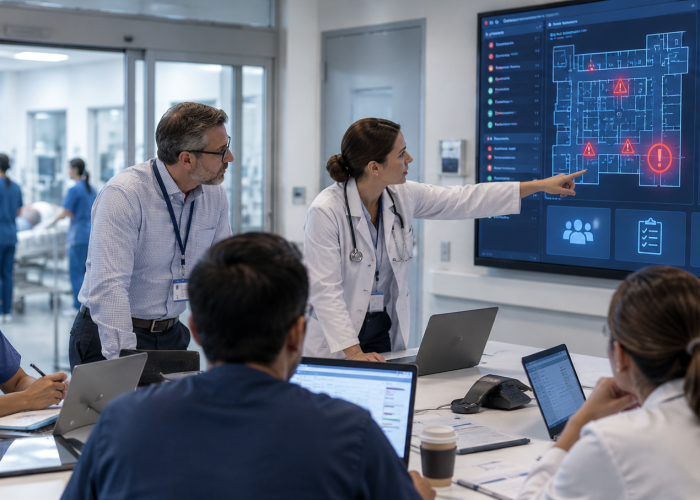
An incident command system in healthcare becomes critical when a cyberattack stops being only a technology problem and begins disrupting patient care. Imagine employees suddenly losing access to the EHR at 8:17 a.m., followed by laboratory interfaces failing, pharmacy orders disappearing, and communication systems becoming unreliable. Within minutes, the organization may be dealing with a healthcare emergency rather than a routine IT outage.
At that point, cybersecurity teams still need to investigate whether ransomware, network failure, compromised credentials, or another event caused the disruption. But the organization simultaneously needs decisions about patient flow, downtime procedures, medication processes, communications, staffing, and clinical priorities. Those responsibilities cannot sit with IT alone.
The central leadership question becomes simple: Who is actually in command? A structured incident command approach gives hospitals, physician practices, specialty clinics, ambulatory facilities, and other healthcare organizations a framework for coordinating technical recovery with operational continuity. That coordination can help reduce confusion when technology failures begin affecting real patient-care workflows.
Cyber Incidents Can Become Healthcare Emergencies Quickly
Healthcare cyber response traditionally focuses on technical activities such as isolating compromised systems, blocking malicious traffic, resetting accounts, reviewing logs, restoring backups, and determining the root cause. Those actions remain essential because stopping the attack is necessary before systems can safely return to service. However, technical containment represents only one part of the response.
While IT teams investigate, clinicians still need to know whether they can continue performing procedures. Nurses need access to medication and patient information, laboratories need ways to deliver results, and front-desk teams need alternate scheduling workflows. Executives may also need to decide whether services should be reduced or patients diverted.
This is why healthcare cybersecurity and emergency management increasingly overlap. A significant ransomware incident can affect the same operational functions disrupted during other healthcare emergencies: staffing, communications, supply availability, patient flow, documentation, and executive decision-making. Incident Command provides a structure for managing those interconnected consequences.
What Is an Incident Command System?
The Incident Command System, or ICS, is a structured framework used to organize emergency response. Within healthcare, many organizations adapt these principles through the Hospital Incident Command System, commonly known as HICS. The goal is to create clear authority, defined responsibilities, and coordinated decision-making when normal operations are disrupted.
An incident command system in healthcare generally organizes response around five core functions: Command, Operations, Planning, Logistics, and Finance/Administration. Each function addresses a different category of emergency management while supporting the same incident objectives. This prevents every department from improvising independently.
The value is not simply the organizational chart. It is that leaders understand who is setting priorities, who is executing operational decisions, who is looking ahead, who is obtaining resources, and who is tracking financial and administrative consequences. During a cyber incident, that clarity can significantly improve coordination.
Why Cyber Response Needs More Than IT
Cybersecurity teams are responsible for containing attacks and restoring technical confidence, but they cannot independently decide how patient care should continue during an outage. Clinical leadership understands which services are essential, which workflows can safely move to paper, and where patient-safety risks are increasing. Emergency management teams understand how to coordinate organization-wide response.
A healthcare incident management team may therefore include representatives from:
- Cybersecurity and IT
- Clinical operations
- Nursing leadership
- Medical leadership
- Emergency management
- Pharmacy
- Laboratory and imaging
- Communications
- Legal and privacy
- Finance
- Facilities
- Executive leadership
These teams need to operate as one response structure rather than parallel groups. IT may know which systems can technically return first, but clinical leaders may know which systems need to return first to reduce patient-care risk. Incident Command creates the forum for making those decisions together.
Command: Establish the Priorities
The Command function establishes overall objectives for the incident. During a healthcare ransomware event, those priorities will usually begin with patient safety while also addressing containment, continuity, communication, and safe recovery. Clear objectives prevent departments from pursuing conflicting goals.
A practical priority structure may include:
- Protect patient safety
- Contain the cyberattack
- Maintain critical healthcare services
- Establish reliable communications
- Restore systems safely
These priorities can evolve as new information becomes available. A suspected network failure may later be confirmed as ransomware, or an outage initially expected to last two hours may require a full day of recovery. Command provides a consistent place for reassessing objectives.
Operations: Keep Healthcare Functioning
Operations manages the immediate work required to maintain clinical and business functions. During a major cyber outage, this may include activating downtime procedures, moving to paper workflows, adjusting patient flow, reassigning staff, and coordinating medication or laboratory processes. Different departments may require different levels of support.
Clinical operations also need to determine whether certain services can safely continue. An emergency department may face different constraints than an outpatient clinic, imaging center, or medical billing office. Incident Command allows those operational differences to be considered without losing organization-wide coordination.
The objective is not to recreate normal operations perfectly. It is to maintain the safest and most critical functions possible until technical systems can be restored. That distinction is important during prolonged outages.
Planning: Prepare for the Next Several Hours
Planning looks beyond the immediate response. If the outage continues for another four hours, which clinical departments will struggle first? If recovery takes 24 hours, what staffing, documentation, or patient-flow challenges will emerge?
This function helps the organization prepare for future operational limits rather than waiting until they become emergencies. Planning may develop incident action plans, track system status, document available resources, and identify dependencies between clinical and technical recovery. Cybersecurity teams can contribute realistic recovery estimates.
The planning process should consider multiple scenarios. Leadership may need different strategies for a short EHR interruption, a full-day ransomware outage, or a multiday disruption affecting both communications and clinical applications. Scenario-based planning improves decision quality as circumstances change.
Logistics: Support the Downtime Environment
Cyberattacks can create unexpected logistical needs because many modern healthcare workflows assume digital systems will always be available. Once those systems disappear, staff may suddenly need physical forms, radios, backup devices, additional personnel, runners, and alternative communication tools. Logistics coordinates these resources.
Facilities may also become part of the response. Conference rooms may become command centers, printed downtime packets may need to be distributed, and devices or portable equipment may need to be relocated. External vendors may also require controlled access to assist with recovery.
Logistics should be planned before an incident occurs. Healthcare organizations that wait until ransomware shuts down the network to determine where backup radios, paper forms, or emergency contact lists are stored have already lost valuable response time.
Finance and Administration: Track the Cost and Documentation
Significant cyber incidents create financial and administrative consequences that begin immediately. Emergency purchases, overtime, outside forensic support, vendor assistance, lost revenue, legal expenses, and recovery costs may all need documentation. Finance and Administration ensures these activities are recorded consistently.
Detailed financial records can support insurance claims, regulatory analysis, executive reporting, and post-incident review. Healthcare organizations may also need documentation showing when key operational decisions were made and who authorized emergency expenditures. This becomes increasingly important as an incident grows in duration and complexity.
Cyber incidents can continue generating costs long after systems return to service. Investigation, legal review, patient notification, remediation, monitoring, and infrastructure changes may continue for months. Accurate incident records improve the organization’s ability to understand the real impact.
Plan for Communications to Fail
Healthcare organizations frequently coordinate emergencies through email, messaging platforms, VoIP phones, shared drives, or cloud collaboration tools. A cyberattack may disrupt exactly those technologies. A communications plan that assumes normal communication systems will remain available can therefore fail when it is needed most.
Healthcare organizations should maintain offline contact lists and predefined alternative communication methods. These may include radios, emergency mobile numbers, physical command locations, runners, secure alternate platforms, or other backup methods appropriate to the organization. Critical response procedures should also be accessible when the network is unavailable.
A cyber-response plan stored only on a file server that ransomware has encrypted is not an effective emergency plan. Important procedures, escalation contacts, and downtime instructions should remain available through protected offline or hard-copy methods. Resilient communication is part of resilient incident command.
Define Who Activates Incident Command
One of the most important decisions should be made before a cyberattack begins: who has authority to activate Incident Command? Waiting for an executive meeting while patient-care systems remain unavailable can delay coordinated response. Activation criteria should be documented clearly.
Healthcare organizations may choose to activate Incident Command when cyber events affect critical systems, multiple departments, patient safety, communications, or expected downtime thresholds. The trigger does not need to wait for forensic confirmation that ransomware caused the disruption. Operational impact can justify activation before the technical root cause is known.
The system can then scale according to incident severity. A smaller outage may require a limited Incident Management Team, while a widespread ransomware event may require a fully staffed command structure. Scalability keeps the process practical.
System Restoration Needs Clinical Prioritization
Cybersecurity recovery is not simply a matter of restoring whichever server is easiest to bring online first. Healthcare systems have operational dependencies, and restoring them in the wrong sequence can create new problems. Technical teams therefore need input from clinical operations.
For example, identity infrastructure may need to return before users can access multiple clinical applications. Laboratory interfaces may depend on integration engines, while medication workflows may depend on EHR connectivity. Incident Command helps establish restoration priorities based on both technical dependencies and patient-care impact.
Systems should also be validated before reconnection. Restoring services quickly but reconnecting compromised technology can restart an attack or corrupt recovery efforts. Clinical urgency must be balanced with cybersecurity confidence.
Downtime Procedures Should Be Treated as Operational Controls
Paper workflows and downtime procedures are sometimes considered secondary documentation rather than cybersecurity controls. In reality, they directly influence the organization’s ability to withstand ransomware and prolonged outages. A healthcare organization that can safely operate during disruption gives attackers less operational leverage.
Downtime processes should address medication management, patient identification, clinical documentation, laboratory results, scheduling, orders, admissions, transfers, and communications where applicable. Staff should know where forms are located and how information will later be reconciled when systems return. The process should also account for prolonged outages rather than only brief interruptions.
Organizations should periodically verify that downtime procedures still match current technology and workflows. New cloud systems, clinic locations, vendors, or clinical processes can make old plans obsolete. Downtime readiness must evolve with the environment.
Practice Cyber Downtime Like a Real Emergency
A written incident-response plan provides limited value if teams have never practiced using it. Healthcare organizations should conduct exercises that require clinical, executive, emergency management, legal, communications, and IT personnel to make decisions under realistic time pressure. Exercises should intentionally introduce worsening conditions.
A tabletop exercise could begin with:
- 8:00 a.m. — EHR unavailable
- 9:00 a.m. — Phones begin failing
- 10:30 a.m. — Laboratory interfaces remain unavailable
- 11:00 a.m. — IT confirms ransomware
- 12:00 p.m. — Recovery estimate expands to at least 24 hours
Participants should then determine who activates Incident Command, who declares downtime, whether patient diversion becomes necessary, and how clinical staff receive updates. Teams should also decide which systems receive restoration priority and who authorizes reconnection.
This is a more meaningful preparedness test than simply asking whether the organization has backups. Backups are one technical capability. Cyber resilience requires the organization to continue functioning while those backups are being restored.
Test Communications During Exercises
Exercises should deliberately remove communication systems. Participants may be told that email is inaccessible, collaboration platforms are unavailable, or VoIP phones have stopped working. The response should continue using predefined alternatives.
This tests whether contact lists are accessible offline and whether leaders know how to reach one another. It also exposes practical problems such as outdated numbers, insufficient radios, or uncertainty about where the command team should physically meet. These are easier to correct during an exercise than during ransomware.
Alternative communication processes should include appropriate privacy and security considerations. Emergency communications still need to protect sensitive information when possible. Operational urgency should not automatically eliminate data-protection responsibilities.
Connect Penetration Testing to Patient-Care Impact
Vulnerability assessments and penetration testing reveal technical weaknesses that attackers could exploit. Healthcare organizations should connect those findings to the operational systems they support. A vulnerability becomes more meaningful when leadership understands which patient-care workflows could fail if attackers successfully exploit it.
Suppose penetration testing reveals that compromise of a single identity platform could disrupt EHR access, cloud applications, remote connectivity, and several clinical systems. That is not merely a technical finding for the IT department. The dependency belongs in the organization’s emergency and downtime planning.
This is where incident command system in healthcare planning and cybersecurity testing reinforce each other. Security testing identifies potential failure paths, while operational planning determines how the healthcare organization would continue functioning if one of those paths were successfully exploited.
Understand Dependencies Before the Emergency
Healthcare applications frequently depend on infrastructure that clinical users rarely see. EHR access may depend on identity providers, DNS, network connectivity, cloud services, integration engines, and vendor systems. Failure of one supporting technology can therefore disrupt several clinical applications simultaneously.
Organizations should map these dependencies before an incident occurs. Incident Command can then use those maps to understand why several services may fail together and which restoration actions provide the greatest operational benefit. Technical architecture becomes part of business continuity planning.
Dependency mapping is particularly useful for third-party services. A healthcare organization may have healthy internal systems while a critical vendor remains offline. Incident plans should account for external failures as well as direct attacks against internal technology.
Incident Command and HIPAA Contingency Planning
HIPAA does not require healthcare organizations to implement a specific Incident Command System. However, the HIPAA Security Rule includes contingency-planning requirements addressing data backup, disaster recovery, emergency-mode operations, and continuation of critical business processes involving ePHI. A structured command model can help coordinate those responsibilities during a real event.
The technical cybersecurity response should remain distinct from broader emergency management responsibilities while operating within the same coordinated structure. Security teams determine whether systems are compromised and when technical conditions support restoration. Incident Command determines how organizational priorities and resources are managed during that process.
Documentation also matters. Organizations should record significant actions, system status, operational decisions, and recovery milestones. These records can support later risk analysis, compliance reviews, insurance processes, and improvements to the incident-response program.
Final Thoughts
An incident command system in healthcare provides the structure necessary when cyber incidents grow beyond the IT department and begin affecting patient care, communications, staffing, pharmacy, laboratories, and clinical operations. Cybersecurity teams still need to isolate compromised systems and restore technology, but the broader healthcare organization needs clear authority for maintaining operations while that work continues. Command, Operations, Planning, Logistics, and Finance/Administration provide a common structure for managing those responsibilities.
The server may be where the incident begins, but patient care is where the consequences are ultimately felt. Healthcare cyber resilience therefore requires more than backups and malware protection—it requires leadership, downtime readiness, alternative communications, operational coordination, and regular exercises that prove the organization can function while technology is unavailable. For practical guidance on healthcare cybersecurity, incident response, HIPAA security, ransomware preparedness, penetration testing, and cyber resilience, follow Tempest Healthcare IT on LinkedIn: https://www.linkedin.com/company/tempesthealthcareit/