
One Click Can Disrupt Care: Why Healthcare Phishing Defense Must Go Beyond Awareness
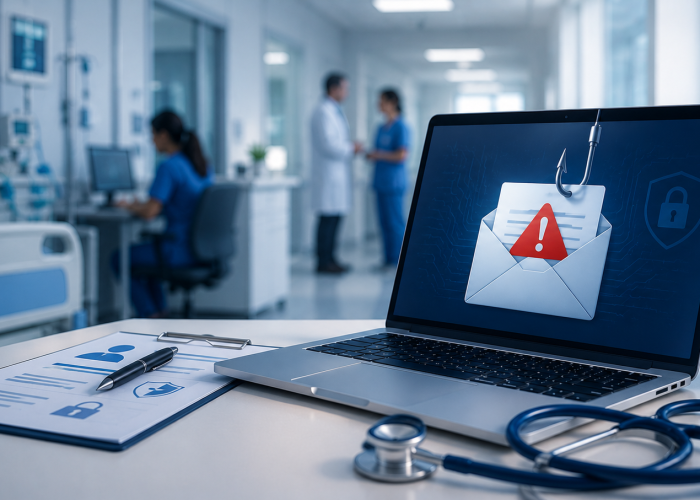
Healthcare phishing defense has been a point of cybersecurity priority for hospitals, physician practices, specialty clinics, ambulatory surgery centers, behavioral health organizations, and medical billing providers across the United States. While ransomware often dominates cybersecurity headlines, many healthcare breaches begin with something far less technical—a single employee clicking what appears to be a legitimate email or attachment. Building an effective healthcare phishing defense means protecting not only patient information but also the clinical workflows and operational systems that support safe patient care.
Healthcare organizations operate in an environment where speed, trust, and communication are essential. Clinicians respond to urgent requests throughout the day, administrative teams process time-sensitive documents, and IT departments manage thousands of authentication requests across cloud platforms, Electronic Health Records (EHRs), and third-party applications. Cybercriminals understand these pressures and increasingly design phishing campaigns that exploit normal healthcare workflows instead of relying on obvious scam emails.
Modern phishing attacks are significantly more sophisticated than they were only a few years ago. Threat actors now combine polished email templates, cloned login pages, AI-generated writing, voice impersonation, stolen employee information, and realistic branding to create messages that appear completely legitimate. Rather than attempting to bypass firewalls directly, attackers often target the people using the technology because trust is frequently easier to exploit than software vulnerabilities.
Healthcare phishing defense therefore requires far more than annual awareness training. Organizations need layered technical safeguards, identity protections, secure workflows, continuous monitoring, and realistic employee education that reflects how healthcare professionals actually work. A single click should never become the only barrier between an attacker and sensitive patient information.
Why Phishing Remains One of Healthcare’s Biggest Cybersecurity Risks
Healthcare organizations manage enormous volumes of valuable information every day. Electronic Protected Health Information (ePHI), insurance records, payment data, personally identifiable information (PII), prescription histories, laboratory results, imaging reports, and financial records all represent attractive targets for cybercriminals.
Unlike credit card numbers, medical records often retain long-term value because they contain multiple forms of personal information that cannot easily be replaced. Attackers can use stolen healthcare information for insurance fraud, identity theft, financial crime, extortion, and even targeted social engineering campaigns.
Healthcare also depends heavily on uninterrupted access to digital systems. Electronic Health Records, scheduling platforms, pharmacy systems, laboratory interfaces, patient portals, and billing applications all support daily clinical operations. When phishing attacks lead to ransomware or account compromise, patient care itself may be affected.
The Ascension Cyberattack Demonstrates the Real Impact
One of the clearest examples of why healthcare phishing defense matters occurred during the 2024 cyberattack affecting Ascension, one of the largest nonprofit health systems in the United States.
Ascension reported detecting unusual activity across portions of its technology environment, resulting in disruptions that required organizations throughout the health system to activate downtime procedures while incident response teams investigated and restored affected systems. Clinical staff temporarily relied on manual workflows to continue delivering patient care while cybersecurity specialists worked alongside incident response experts.
Subsequent public reporting indicated that the ransomware incident began after an employee downloaded a malicious file that appeared legitimate. Ascension emphasized that the event resulted from an honest mistake rather than intentional misconduct, highlighting an important lesson for healthcare organizations: even well-trained employees can become victims of sophisticated phishing campaigns.
The operational consequences extended well beyond IT. Clinical workflows were disrupted, Electronic Health Record access required gradual restoration, and millions of individuals were ultimately affected. The incident reinforced that phishing is no longer simply an email security issue—it represents a patient safety, operational continuity, financial, and regulatory challenge.
Why Social Engineering Is So Effective in Healthcare
Healthcare professionals are trained to respond quickly. Physicians answer urgent consultations, nurses coordinate patient care, finance teams process time-sensitive requests, and administrators routinely communicate with vendors, insurance providers, laboratories, and external partners.
Cybercriminals carefully study these behaviors when designing phishing campaigns. Rather than relying on generic spam messages, attackers increasingly craft highly targeted emails, phone calls, text messages, and support requests that appear consistent with everyday healthcare operations.
Federal cybersecurity advisories issued jointly by the FBI and HHS have warned that healthcare organizations continue facing phishing campaigns specifically designed to steal credentials, compromise employee email accounts, manipulate payment workflows, and deceive IT help desks into resetting passwords or enrolling fraudulent multi-factor authentication devices.
These attacks succeed because they exploit normal business processes instead of technical weaknesses alone.
Healthcare Phishing Defense Must Go Beyond Awareness
Employee education remains an essential component of cybersecurity, but awareness training alone cannot stop modern phishing attacks. Even experienced professionals occasionally make mistakes, particularly when operating under clinical pressure or responding to urgent requests.
An effective healthcare phishing defense assumes that some phishing attempts will eventually succeed. Rather than relying solely on employee judgment, organizations should implement multiple security layers that reduce the impact of human error.
This philosophy reflects modern Zero Trust principles by assuming credentials may eventually become compromised while limiting the damage attackers can cause afterward.
Layer 1: Strengthen Email Security
Email remains the most common delivery method for phishing attacks. Modern healthcare organizations should deploy layered email security capable of detecting spoofing, malicious attachments, suspicious URLs, impersonation attempts, and fraudulent domains before messages ever reach employees.
Advanced email filtering significantly reduces employee exposure to phishing campaigns while decreasing overall organizational risk. Technologies such as SPF, DKIM, and DMARC further strengthen email authentication by making domain spoofing more difficult for attackers.
Reducing malicious email delivery remains one of the most effective preventive cybersecurity investments.
Layer 2: Require Multi-Factor Authentication Everywhere
Passwords alone no longer provide sufficient protection for healthcare systems. Stolen credentials frequently appear in phishing attacks, password reuse campaigns, and data breaches affecting unrelated organizations.
Multi-Factor Authentication (MFA) adds another verification layer that makes unauthorized access significantly more difficult even after passwords have been compromised. Healthcare organizations should extend MFA beyond administrators to include remote access, cloud applications, patient management platforms, email services, and privileged accounts.
Whenever possible, phishing-resistant authentication methods should replace traditional SMS-based verification.
Layer 3: Secure the IT Help Desk
Modern phishing campaigns increasingly target healthcare IT help desks rather than end users directly. Attackers impersonate employees, claim lost mobile devices, request password resets, or attempt to enroll new authentication devices using information gathered from public sources or previous data breaches.
Help desk personnel therefore represent critical components of healthcare phishing defense. Organizations should implement strict identity verification procedures before approving password resets, MFA enrollment changes, account recovery requests, or privileged access modifications.
Independent callbacks, supervisor approval, documented verification procedures, and standardized escalation processes significantly reduce social engineering success rates.
Layer 4: Limit the Damage of Compromised Accounts
Even strong phishing prevention cannot guarantee complete protection. Organizations should therefore minimize what compromised accounts can access if attackers successfully obtain valid credentials.
Least privilege access, conditional access policies, network segmentation, privileged access management, and continuous identity monitoring all help prevent attackers from expanding beyond initially compromised accounts.
By restricting lateral movement, healthcare organizations reduce opportunities for attackers to access Electronic Health Records, billing platforms, and other high-value systems.
Layer 5: Provide Realistic Security Training
Annual cybersecurity awareness presentations rarely reflect how phishing attacks actually occur within healthcare environments. Effective education programs should continuously expose employees to realistic attack scenarios specific to their daily responsibilities.
Clinical staff, finance teams, billing specialists, executives, IT administrators, and help desk personnel each encounter different phishing techniques. Role-based training allows organizations to prepare employees for the threats they are most likely to encounter.
Regular phishing simulations also provide measurable insight into organizational readiness while identifying departments requiring additional education.
Layer 6: Detect Suspicious Activity Quickly
Cybersecurity does not end after an employee clicks a malicious link. Rapid detection often determines whether a phishing attempt becomes a minor security event or a major organizational incident.
Healthcare organizations should implement centralized logging, endpoint detection, behavioral analytics, identity monitoring, abnormal login detection, remote access auditing, and Security Information and Event Management (SIEM) capabilities. Early visibility enables security teams to isolate compromised accounts before attackers expand throughout the network.
Fast response frequently prevents ransomware deployment and large-scale data theft.
Supporting HIPAA Compliance Through Healthcare Phishing Defense
The HIPAA Security Rule requires covered entities and business associates to implement reasonable administrative, technical, and physical safeguards that protect electronic Protected Health Information. While HIPAA does not prescribe specific phishing technologies, organizations are expected to address reasonably anticipated threats affecting confidentiality, integrity, and availability.
Healthcare phishing defense supports these requirements by reducing credential theft, strengthening authentication, improving employee awareness, enhancing monitoring, and documenting risk mitigation efforts. Together, these controls contribute to broader organizational cybersecurity maturity.
Demonstrating ongoing improvements in phishing defense also supports security assessments, cyber insurance applications, and regulatory reviews.
Continue Learning with Tempest Healthcare IT
Cyber threats continue evolving, making ongoing education an essential part of every healthcare cybersecurity strategy. At Tempest Healthcare IT, we regularly publish practical resources covering HIPAA compliance, phishing defense, vulnerability management, penetration testing, Microsoft security solutions, and emerging threats affecting healthcare organizations.
Follow Tempest Healthcare IT on LinkedIn for healthcare cybersecurity insights, educational resources, and practical guidance designed specifically for hospitals, physician practices, specialty clinics, and healthcare IT professionals.
LinkedIn: https://www.linkedin.com/company/tempesthealthcareit