
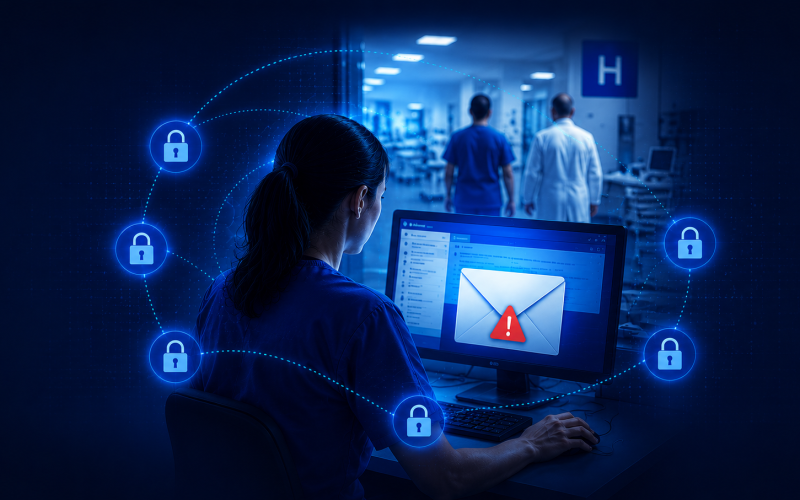
Beyond the Perimeter: What Happens After Someone Clicks the Phishing Email?
Most healthcare cybersecurity training focuses on one goal: don’t click the phishing email. It’s a message healthcare organizations repeat constantly—and for good reason. Phishing remains one of the most common entry points for cyberattacks, ransomware incidents, and data breaches across the healthcare industry.
However, there is an uncomfortable reality that every healthcare leader should acknowledge. People will click. Even well-trained employees, security-conscious organizations, and healthcare systems with mature cybersecurity programs experience successful phishing attempts.
That’s why healthcare organizations need to rethink the question they’re asking. Instead of asking, “Can we prevent every phishing click?” a more important question may be: “What happens after the click?” Because that’s where many breaches become catastrophic.
Phishing Is Usually the Beginning, Not the End
Many organizations still view phishing as a standalone threat. In reality, phishing is often just the first step in a much larger attack. Once attackers gain access to a user account, workstation, or cloud application, they rarely launch ransomware immediately.
Instead, they begin gathering information and exploring the environment. Their objectives often include mapping the network, harvesting credentials, identifying privileged accounts, discovering sensitive data repositories, locating backup systems, and finding paths to critical business applications. The ultimate goal is to move from a low-value entry point to high-value systems.
This process is known as lateral movement. It is one of the most overlooked risks in healthcare cybersecurity. Understanding how attackers move within an environment is critical to limiting the impact of a breach.
What Is Lateral Movement?
Lateral movement refers to the techniques attackers use to move through a network after gaining an initial foothold. Rather than targeting critical systems directly, attackers often compromise an employee account or workstation and then expand their access. Their objective is to reach systems that contain valuable data or provide broader control over the environment.
A successful phishing attack against a front-desk employee may initially seem limited. However, without proper security controls, that compromise can become a gateway to scheduling platforms, billing systems, shared file servers, clinical applications, and Electronic Health Records. What starts as one compromised device can rapidly become an organization-wide incident.
Why Lateral Movement Is a Major Healthcare Risk
Healthcare environments are uniquely attractive to attackers because of their interconnected nature. Clinical teams, administrative staff, vendors, and technology platforms must communicate and share information to support patient care. Unfortunately, highly connected environments can also make it easier for attackers to move between systems.
If networks are not properly segmented, a compromise in one area may expose multiple business functions. Patient records, clinical operations, scheduling systems, revenue cycle management platforms, and administrative applications may all become accessible. In many cases, operational disruption becomes just as damaging as the data breach itself.
Unauthorized access to protected health information (PHI) and electronic protected health information (ePHI) can trigger regulatory investigations, breach notifications, and compliance concerns. Clinical workflows may be disrupted, patient scheduling may be affected, and billing systems may become unavailable. These consequences highlight why lateral movement is such a serious healthcare cybersecurity risk.
Why Prevention Alone Is No Longer Enough
Healthcare cybersecurity strategies have traditionally focused on perimeter defense. Organizations invested heavily in firewalls, antivirus software, email filtering, intrusion prevention systems, and endpoint protection. These controls remain important, but they are no longer sufficient on their own.
Modern cybersecurity requires organizations to assume that some attacks will eventually succeed. No security awareness program can guarantee that every employee will recognize every phishing attempt. Likewise, no email security platform can block every malicious message.
The question is no longer whether attackers can gain access. The more important question is how far they can go once they do. Organizations that focus only on prevention may overlook the controls needed to contain an attack after the initial compromise.
Network Segmentation: The Fire Doors of Cybersecurity
One of the most effective ways to limit lateral movement is through network segmentation. Think of network segmentation like fire doors inside a hospital. If a fire starts in one room, the goal is to prevent it from spreading throughout the building.
Fire barriers help contain damage and protect critical areas. Network segmentation works the same way by creating boundaries between systems and limiting unnecessary communication. If an attacker compromises one area of the network, segmentation helps prevent them from moving freely throughout the environment.
Instead of allowing unrestricted access between systems, organizations create logical barriers around critical assets. Every barrier slows attackers down and provides security teams with additional opportunities to detect and stop malicious activity. Effective segmentation can significantly reduce the scope and impact of a cyber incident.
How Network Segmentation Protects Healthcare Organizations
Properly designed network segmentation creates multiple layers of protection throughout a healthcare environment. Clinical systems can be separated from general business operations, reducing the risk that an administrative compromise affects patient care systems. Medical devices can also be isolated from administrative networks and internet-facing systems.
Administrative functions such as accounting, human resources, and operational systems can be separated from patient care environments. Sensitive patient and financial databases can be protected behind additional layers of security and access control. These protections make it more difficult for attackers to move laterally through the organization.
Threat containment improves significantly when segmentation is implemented correctly. Attackers encounter barriers at each stage of the attack, increasing opportunities for detection and response. Every delay creates another chance to stop the breach before it reaches critical systems or sensitive data.
The Role of Zero Trust Security
Network segmentation aligns closely with modern Zero Trust security principles. Zero Trust assumes that no user, device, or system should automatically be trusted simply because it is inside the network. Instead, trust must be continuously verified.
Organizations should continuously evaluate user identities, device health, access permissions, application requests, and network activity. This approach reduces the likelihood that a compromised account can move freely throughout the environment. By combining segmentation with Zero Trust architecture, healthcare organizations can significantly reduce lateral movement risk.
Questions Every Healthcare Leader Should Ask
Healthcare executives, compliance officers, and IT leaders should regularly evaluate their organization’s exposure to lateral movement. One of the most important questions is: If one employee account were compromised, what could an attacker access? Understanding the answer can help identify critical security gaps.
Leaders should also determine whether clinical systems are segmented from administrative systems. Critical patient care applications should not be directly accessible from every workstation on the network. Medical devices should also operate within controlled network segments whenever possible.
Organizations should assess whether they can detect lateral movement activity in real time. Monitoring for unusual access patterns, privilege escalation attempts, and suspicious network activity can help identify attacks before they spread. Regular security assessments can also reveal pathways attackers may exploit.
Network Segmentation and HIPAA Compliance
The HIPAA Security Rule requires healthcare organizations to implement safeguards that protect the confidentiality, integrity, and availability of ePHI. While HIPAA does not specifically mandate network segmentation, segmentation supports several important security objectives. These include access control, risk management, data protection, incident response, and security monitoring.
Organizations that segment critical systems often reduce both cybersecurity risk and compliance exposure. Limiting access to sensitive systems can help prevent unauthorized access and reduce the impact of security incidents. Segmentation also supports stronger security governance and risk management practices.
Building Healthcare Cyber Resilience
The most resilient healthcare organizations understand an important truth: breaches are not always preventable. However, catastrophic breaches often are. Cyber resilience is not defined by whether attackers gain initial access, but by how effectively organizations contain and respond to attacks.
Resilient organizations invest in network segmentation, identity security, multi-factor authentication, security monitoring, incident response planning, and security awareness training. They also prioritize business continuity planning to ensure critical operations can continue during disruptions. Together, these controls help reduce the impact of successful attacks.
Looking Beyond the Perimeter
Healthcare cybersecurity is evolving rapidly. Organizations can no longer rely solely on perimeter defenses and phishing awareness training. Those protections remain important, but they are only one part of a broader security strategy.
Healthcare leaders should assume that eventually someone will click a phishing email. An account may be compromised, and an attacker may gain access. The real question is what happens next.
If an attacker compromised a single employee account tomorrow, how many systems could they reach? If the answer is unclear, it may be time to look beyond the perimeter. Understanding and limiting lateral movement could be the difference between a minor security event and a major breach.
Strengthening Healthcare Security Through Containment
Modern healthcare cybersecurity is not just about preventing attacks. It is about limiting the damage when prevention fails. Organizations that embrace this mindset are better prepared to withstand today’s evolving threats.
Network segmentation helps healthcare organizations create the digital equivalent of fire doors. By slowing attackers, protecting critical systems, and reducing the likelihood that a single compromised device becomes a full-scale breach, segmentation strengthens both security and resilience. In healthcare, resilience is not measured by whether an attacker gets in—it is measured by how effectively you stop them from going further.
About Tempest Healthcare IT
Tempest Healthcare IT helps healthcare organizations strengthen cybersecurity, improve HIPAA compliance, develop disaster recovery strategies, and build operational resilience. Through healthcare-focused cybersecurity services, risk assessments, business continuity planning, and recovery preparedness programs, Tempest Healthcare IT helps providers protect patient care and critical technology systems.
Learn more: https://www.tempesthealthcareit.com/
Follow Tempest Healthcare IT: