
SaaS Configuration Attacks in Healthcare: What the UNC6508 Google Workspace Breach Teaches Healthcare Leaders
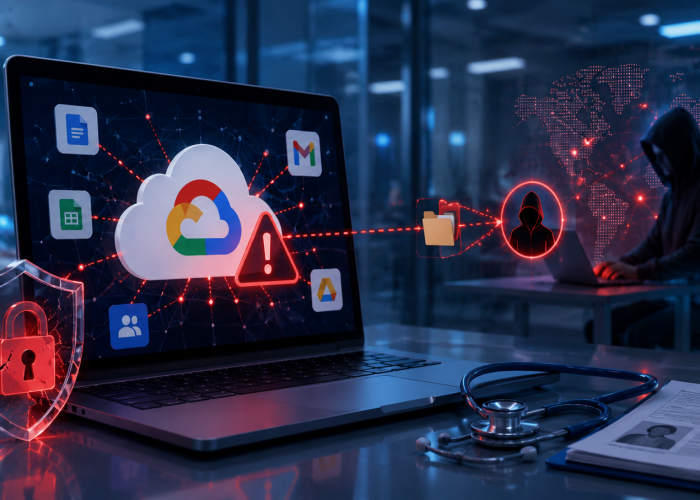
A sophisticated state-sponsored threat group tracked by Google Threat Intelligence as UNC6508 spent more than a year quietly stealing research data, public health information, and sensitive communications from organizations across North America.
The attackers did not deploy ransomware. They did not generate large-scale data exports or trigger many traditional security alerts.
Instead, they leveraged the victims’ own cloud infrastructure to conduct espionage.
For healthcare providers, research institutions, biotech organizations, universities, and public health agencies, this attack represents a significant shift in how modern cyber threats operate.
The Evolution of Healthcare Cyber Threats
Healthcare organizations have become attractive targets for cybercriminals, nation-state actors, and advanced persistent threat groups because of the immense value of the data they possess.
Electronic Protected Health Information (ePHI), clinical research, intellectual property, public health initiatives, pharmaceutical development, and government-funded projects all represent valuable targets.
Historically, attackers often relied on ransomware, malware deployment, or large-scale data theft operations to achieve their objectives.
Today, sophisticated threat actors are increasingly pursuing a quieter approach.
Rather than attacking endpoints directly, they are targeting cloud applications, identity systems, administrative privileges, and Software-as-a-Service (SaaS) configurations.
The UNC6508 campaign highlights exactly how dangerous this strategy can be.
Understanding the UNC6508 Attack Campaign
According to Google Threat Intelligence, UNC6508 conducted a multi-stage operation that targeted healthcare organizations, research institutions, universities, and technology sectors.
The campaign demonstrates how attackers can move from an initial compromise to long-term intelligence collection without relying on traditional malware-based exfiltration methods.
The attack unfolded across four distinct phases.
Stage One: Exploiting Vulnerable REDCap Environments
The attackers initially targeted internet-facing servers running REDCap (Research Electronic Data Capture).
REDCap is widely used throughout healthcare, higher education, clinical research, and public health organizations to manage patient surveys, research studies, clinical data collection, and regulatory reporting.
Because REDCap often contains highly sensitive research and patient information, it represents an attractive target for advanced threat actors.
Google’s investigation found that attackers exploited vulnerable or unpatched REDCap environments to gain their initial foothold.
Once access was established, the threat actors deployed web shells that allowed them to maintain persistence within the environment.
This initial compromise provided the foundation for the broader attack.
Stage Two: Intercepting Legitimate Software Updates
After gaining access, the attackers deployed custom malware known as InfiniteRed.
Unlike traditional malware that creates obvious malicious processes, InfiniteRed reportedly operated by intercepting legitimate software updates and modifying official application files.
This approach allowed malicious code to execute during normal application operations.
As a result, many traditional security tools had difficulty identifying suspicious activity because the malware blended into legitimate system behavior.
This tactic highlights an important lesson for healthcare organizations.
Attackers increasingly seek ways to operate inside trusted processes rather than creating obvious indicators of compromise.
Stage Three: Harvesting Administrative Credentials
Once InfiniteRed was deployed, the attackers focused on collecting credentials.
As researchers, clinicians, administrators, and other users logged into REDCap, the malware quietly harvested usernames and passwords.
Rather than immediately using the stolen credentials, the attackers accumulated access over time.
Eventually, they obtained privileged administrative credentials that extended far beyond the REDCap environment.
These credentials provided access to broader cloud services and identity systems, including Google Workspace administrative functions.
This stage demonstrates why credential theft remains one of the most effective attack techniques used against healthcare organizations.
Stage Four: Weaponizing Google Workspace Compliance Rules
The most sophisticated phase of the campaign occurred after the attackers gained privileged access to Google Workspace.
Instead of downloading mailbox archives or exporting large amounts of email data, they manipulated existing Google Workspace functionality.
The attackers modified organizational Content Compliance Rules within the Google Workspace Admin Console.
These rules are legitimate administrative features designed to help organizations manage email routing, compliance requirements, and data governance.
The threat actors transformed them into surveillance tools.
How the Email Exfiltration Worked
The attackers reportedly configured approximately 150 keyword-based filters focused on topics of strategic interest.
Examples included:
- Public health initiatives
- Clinical research
- Disease studies
- Aerospace technology
- Drone research
- Government policy
- Geostrategic information
Whenever an incoming or outgoing email matched one of the targeted criteria, Google Workspace automatically generated a hidden copy and forwarded it to attacker-controlled email accounts.
The process occurred entirely within Google’s infrastructure.
No suspicious file transfers were required.
No endpoint malware was actively exporting data.
No large-scale mailbox downloads occurred.
The organization’s own cloud platform unknowingly became the data exfiltration mechanism.
Why Traditional Security Controls Struggled to Detect the Attack
One of the most concerning aspects of the UNC6508 campaign is how effectively it bypassed traditional security monitoring.
Most healthcare organizations focus heavily on:
- Endpoint protection
- Antivirus software
- Firewalls
- Network monitoring
- Intrusion detection systems
- Data loss prevention tools
These controls remain essential.
However, many of them have limited visibility into administrative changes occurring entirely within cloud platforms.
Because the forwarding activity occurred inside Google Workspace:
- No unusual endpoint behavior was observed
- No large outbound file transfers occurred
- Network traffic appeared legitimate
- User activity looked normal
- Endpoint detection tools had little visibility
From a traditional security perspective, very little appeared suspicious.
This represents one of the fastest-growing cybersecurity blind spots facing healthcare organizations today.
The Growing Threat of SaaS Configuration Abuse
The UNC6508 campaign illustrates a larger trend in modern cybersecurity.
Attackers increasingly target cloud configurations rather than endpoints alone.
Once privileged access is obtained, threat actors can manipulate legitimate SaaS functionality to achieve their objectives.
Examples include:
- Email forwarding rules
- Compliance policies
- Administrative permissions
- API integrations
- Identity federation settings
- Cloud storage permissions
- Data retention policies
Because these actions often utilize approved administrative functions, traditional detection mechanisms may not identify them as malicious.
This is known as SaaS configuration abuse.
Why Healthcare Organizations Are Especially Vulnerable
Healthcare organizations rely heavily on cloud platforms such as:
- Google Workspace
- Microsoft 365
- Salesforce
- Azure
- AWS
- Healthcare analytics platforms
- Telehealth applications
- Practice management systems
These environments often contain years of patient data, research information, intellectual property, financial records, and operational communications.
At the same time, many organizations lack dedicated visibility into SaaS configuration changes.
Security teams may monitor devices and networks extensively while having limited insight into administrative activities occurring inside cloud platforms.
This creates opportunities for attackers to operate undetected.
Why Identity Security Matters More Than Ever
The UNC6508 campaign reinforces a critical cybersecurity reality.
Modern attacks increasingly focus on identity rather than infrastructure.
Once attackers obtain privileged credentials, they can often achieve their objectives without deploying malware or exploiting additional vulnerabilities.
This makes identity security one of the most important components of a modern healthcare cybersecurity strategy.
Organizations should prioritize:
- Multi-factor authentication (MFA)
- Privileged Access Management (PAM)
- Identity Governance
- Conditional Access Policies
- Zero Trust Architecture
- Continuous authentication monitoring
Passwords alone are no longer sufficient protection for critical administrative accounts.
The Future of Healthcare Cybersecurity
The UNC6508 campaign demonstrates that healthcare cybersecurity is evolving rapidly.
Attackers no longer need to deploy ransomware or conduct large-scale data theft operations to achieve their objectives.
Instead, they are leveraging legitimate cloud functionality, trusted identities, and administrative controls to operate quietly and persistently.
Healthcare organizations must evolve accordingly.
Protecting endpoints and networks remains essential.
However, organizations must also develop visibility into cloud configurations, SaaS platforms, and identity systems.
Because in modern healthcare cybersecurity, the most dangerous threats may not be hiding on a workstation.
They may already be operating inside your cloud environment.
About Tempest Healthcare IT
Tempest Healthcare IT helps healthcare organizations strengthen cybersecurity, improve HIPAA compliance, secure cloud environments, and reduce cyber risk. Through healthcare-focused SaaS security assessments, penetration testing, identity governance, Zero Trust implementation, Microsoft 365 security reviews, and Google Workspace security assessments, we help providers build resilient security programs that protect patient data and clinical operations.
Learn more:
https://www.tempesthealthcareit.com/
Follow Tempest Healthcare IT: