
Session Cookie Security in Healthcare: Why MFA Alone Cannot Stop Session Hijacking
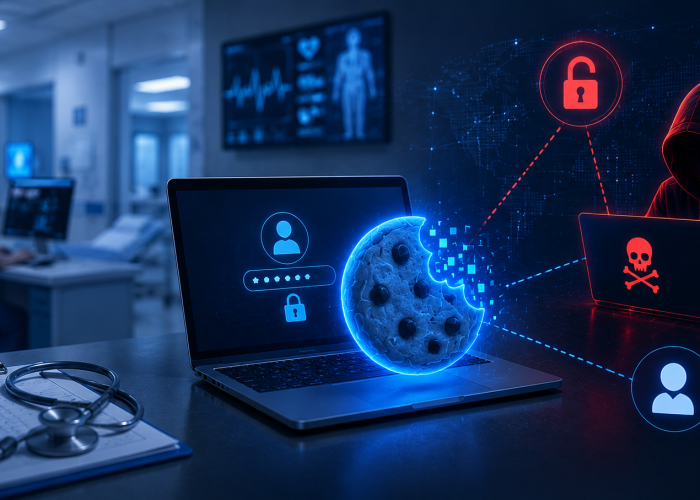
Session cookie security in healthcare addresses a critical part of identity protection that begins after a user successfully completes login and multi-factor authentication. Hospitals, physician practices, medical billing companies, specialty clinics, and other healthcare organizations increasingly rely on browser-based patient portals, cloud EHR systems, scheduling platforms, claims tools, and administrative applications. Securing the login page is essential, but protecting the session that follows is just as important.
Multi-factor authentication significantly raises the difficulty of stealing an account through passwords alone. However, most applications do not ask users to complete MFA every time they click a new page or open another section of an application. Instead, the application creates a session token or cookie that tells the system the user has already been authenticated.
That process is necessary for usability, especially in healthcare environments where clinicians and administrative staff may move rapidly between workflows. The security problem appears when session tokens remain valid for too long, can be replayed from another device, or are poorly monitored. A stolen session can effectively become a temporary substitute for the user’s password and MFA verification.
What Is a Session Cookie?
A session cookie is a small piece of information used by a web application to maintain an authenticated user’s session. After the application verifies credentials and any required MFA challenge, the browser receives a token that allows subsequent requests to remain associated with that authenticated user. Without this mechanism, users would need to authenticate repeatedly while navigating a patient portal or cloud application.
From a security perspective, the session token becomes highly sensitive because possession may represent proof that authentication already occurred. If an attacker steals and successfully reuses that token, the application may treat the attacker as the legitimate user. The attacker is not necessarily defeating MFA; they may be bypassing the need to perform authentication again.
Healthcare organizations should therefore treat active session tokens much like other sensitive credentials. Password security remains important, but protecting authentication artifacts after login needs to become part of the same identity-security strategy. This is particularly relevant as more healthcare workflows move into browser-based cloud platforms.
Why Session Cookies Are Valuable to Attackers
Modern healthcare employees frequently use browsers to access information that was once available only through internal applications. Patient portals, cloud-hosted EHR platforms, payer systems, billing applications, secure messaging, payroll tools, vendor dashboards, and scheduling platforms may all maintain authenticated browser sessions. One compromised endpoint can therefore expose access to multiple critical applications.
Attackers understand this shift and increasingly target browser information rather than focusing only on passwords. If a valid session cookie can be captured and replayed, the attacker may gain access even when the organization’s MFA configuration would normally prevent a new unauthorized login. The application may simply see an existing trusted session.
This risk becomes more serious when sessions remain active for hours or days. Long-lived tokens give attackers a larger window during which stolen session material may remain useful. For small and medium-sized healthcare organizations with distributed workforces and multiple SaaS applications, that exposure can become difficult to manage without centralized identity controls.
Infostealer Malware Has Changed the Risk
Infostealer malware is specifically designed to collect valuable information from infected devices. Depending on the malware family and device configuration, stolen information may include passwords, autofill data, browser profiles, device characteristics, cryptocurrency information, and active session cookies. The resulting data is often packaged for attackers who can attempt to reuse credentials or sessions elsewhere.
This means an employee could follow proper password practices and successfully complete MFA, yet an infected workstation might still expose authenticated browser data afterward. If the attacker receives a usable token, the security battle shifts away from the initial login. The healthcare organization now needs controls capable of identifying suspicious activity within an already-authenticated session.
Endpoint protection therefore plays an important role in session cookie security in healthcare. Preventing infostealers from executing reduces the likelihood that session data will be harvested in the first place. Strong browser management, patching, application control, endpoint detection and response, and employee training should work alongside identity protections.
The Security Gap Between Login and Logout
Many healthcare cybersecurity programs devote substantial attention to the initial login event. Security teams evaluate password strength, MFA enrollment, failed login attempts, conditional access policies, and account lockout thresholds. These controls are valuable, but authentication security should not end once a login is approved.
Organizations also need to understand what happens during the entire authenticated session. They should know how long the session can remain inactive, whether an absolute expiration exists, whether logout invalidates the token on the server, and whether suspicious device or geographic changes trigger additional verification. Without those controls, an authenticated session may continue to be trusted even when the risk surrounding that session changes.
Healthcare applications should therefore treat authentication as a lifecycle rather than a single checkpoint. The application should continuously consider whether the current session still represents the same trusted user and device context that originally authenticated. This becomes especially important for administrative and PHI-heavy systems.
Why Session Hijacking Matters More in Healthcare
A compromised healthcare session may provide access to far more than ordinary corporate information. Depending on the account and application, attackers could potentially view protected health information, claims records, appointment details, insurance information, clinical documentation, internal messages, or financial workflows. Administrative sessions may also allow configuration or permission changes.
Operational consequences can be just as significant as privacy consequences. Attackers who gain access to scheduling, billing, EHR administration, or communications systems may interfere with workflows even without immediately deploying ransomware. This can increase incident-response costs and create disruption that affects both staff and patients.
Healthcare organizations across the United States also operate under regulatory obligations concerning electronic protected health information. Session management weaknesses that enable unauthorized access can therefore become part of a larger HIPAA risk-management and incident-response issue. Strong session controls support both cybersecurity resilience and better protection of patient trust.
Healthcare Session Security for Remote and Cloud Work
Session governance becomes more complex when employees work from multiple locations. Physicians may access cloud applications from home, billing teams may work remotely, vendors may support systems through browser portals, and administrators may use several devices. Each legitimate access pattern can make suspicious behavior more difficult to distinguish from normal activity.
Organizations should combine session controls with device trust, conditional access, geographic context, and identity risk signals. A session suddenly moving from a managed workstation in Florida to an unfamiliar device in another region may deserve additional scrutiny. The specific response should depend on application sensitivity and the organization’s established risk tolerance.
Personal and unmanaged devices require particular attention. Even when access is permitted for operational reasons, sensitive applications may need shorter session durations, stronger reauthentication requirements, or restricted functionality. Device posture should influence how much trust an active session receives.
What Strong Session Cookie Security Looks Like
Healthcare organizations should design session controls around the sensitivity of each application rather than using the same timeout everywhere. Systems containing large volumes of PHI, administrative privileges, billing authority, or security configuration capabilities deserve tighter controls than lower-risk applications. The goal is to reduce attacker opportunity without creating unnecessary clinical disruption.
A practical session-security program should include:
- Short idle timeouts for high-risk applications
- Absolute session expiration limits
- Server-side session invalidation
- Secure, HttpOnly, and appropriate SameSite cookie settings
- Session-token regeneration after authentication or privilege changes
- Immediate revocation after suspected account compromise
- Reauthentication before highly sensitive actions
- Conditional access based on device, location, network, and risk
- Alerts for unusual IP, geography, browser, or device changes
- Central visibility into active sessions
- Endpoint protection against infostealer malware
- Employee awareness training focused on malicious downloads and phishing
These controls should be risk-based rather than arbitrary. A highly privileged administrator may reasonably face stronger reauthentication requirements than a lower-risk employee performing routine tasks. Security teams should work with operational stakeholders so timeout policies protect systems without interfering unnecessarily with patient care.
How Long Should Healthcare Sessions Stay Active?
There is no universal timeout that is appropriate for every healthcare application. Session duration should depend on role, sensitivity, user behavior, device trust, workflow requirements, and the consequences of unauthorized access. High-risk workflows should typically expire more aggressively than low-risk ones.
For example, organizations may consider approximately 15 minutes of inactivity for particularly sensitive administrative or PHI-heavy workflows when that timeout is operationally appropriate. Other applications may require longer inactivity windows to support clinical usability. What matters is that the timeout is intentionally chosen based on risk rather than inherited from a vendor default and forgotten.
Absolute time limits are also valuable because activity alone should not allow a session to remain trusted indefinitely. After a defined period, users can be required to authenticate again even if they have remained active. This creates a natural endpoint for stolen session material.
Reauthentication Should Protect Sensitive Actions
Not every action within an authenticated application carries the same level of risk. Viewing a scheduling dashboard may be less sensitive than modifying administrator permissions, changing payment information, exporting patient records, or updating MFA enrollment. Healthcare applications should account for those differences.
Sensitive actions may warrant fresh authentication or additional verification even when a user already has an active session. This reduces the chance that a stolen session can immediately be used for the highest-impact activities. Reauthentication creates another barrier between basic account access and critical administrative authority.
This approach supports Zero Trust principles by avoiding the assumption that previous authentication grants unlimited trust for the entire session. Trust can be reassessed when the requested action becomes more sensitive. The result is stronger protection without requiring users to authenticate for every routine interaction.
Detecting Suspicious Session Behavior
Good session security requires monitoring as well as expiration. Healthcare organizations should evaluate identity and application activity for patterns that suggest a session has been stolen or transferred. An apparently valid token should not automatically override every other risk signal.
Suspicious indicators may include sudden IP changes, unfamiliar browsers, new devices, impossible travel patterns, unusual access times, high-volume record activity, or behavior inconsistent with the user’s normal role. None of these signals proves compromise by itself, but multiple anomalies should increase scrutiny. Risk-based access systems can respond by requesting reauthentication, blocking the session, or notifying security staff.
Logging is critical because investigators need evidence when suspicious behavior occurs. Organizations should retain appropriate identity, application, and session records so security teams can reconstruct what happened. Cloud applications should also be reviewed to determine what session information vendors make available to customers.
What to Do When Session Theft Is Suspected
A suspected session compromise should trigger rapid containment. Changing the password alone may be insufficient if an existing token continues to be accepted by the application. Incident-response procedures should explicitly address session invalidation.
Organizations should revoke active sessions, investigate relevant endpoints for infostealer malware, review recent logins and device activity, and determine whether PHI or administrative functionality was accessed. MFA enrollment should also be reviewed to ensure attackers did not add their own authentication method or modify legitimate registration data. Monitoring should continue after containment because compromised accounts may be used for follow-on activity.
The investigation should document affected accounts, accessed systems, suspicious sessions, endpoint findings, and any potential exposure of ePHI. This information can support internal incident response, risk analysis, legal review, and any required privacy or breach assessment. Session theft should be treated as an identity-security incident, not merely a password issue.
Final Thoughts
Session cookie security in healthcare closes a critical gap between successful authentication and eventual logout. MFA protects the front door, but stolen tokens can sometimes allow attackers to reuse access that the system has already approved. Shorter session windows, server-side revocation, secure cookie configurations, risk-based reauthentication, endpoint protection, and behavioral monitoring make session hijacking considerably harder.
Healthcare authentication should be viewed as a continuous lifecycle rather than a single login event. Every active session should have an expiration point, monitoring strategy, and rapid method of revocation when risk changes. For more practical guidance on healthcare identity security, HIPAA cybersecurity, penetration testing, vulnerability management, and patient data protection, follow Tempest Healthcare IT on LinkedIn: https://www.linkedin.com/company/tempesthealthcareit/