
Adversarial AI in Healthcare: How Medical Imaging Attacks Could Undermine Clinical Decision-Making
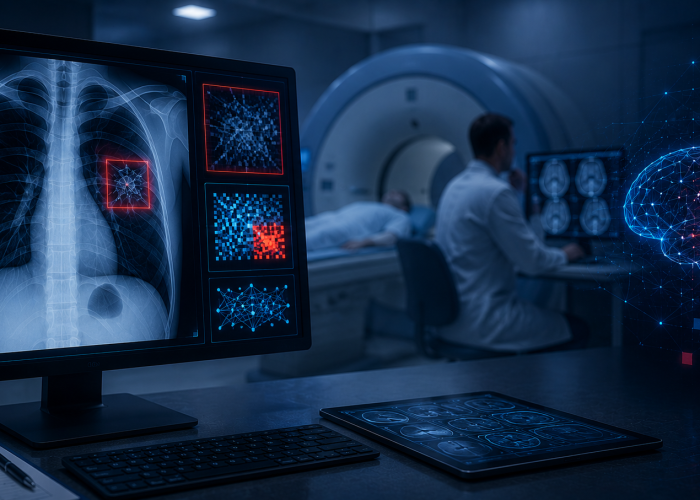
Adversarial AI in healthcare introduces a new cybersecurity challenge that reaches beyond stolen data and ransomware. As hospitals, physician practices, imaging centers, and health systems adopt artificial intelligence for medical imaging, documentation, billing, scheduling, and clinical decision support, they must also protect the information being fed into those systems. If attackers can manipulate AI inputs without noticeably changing what clinicians see, they may be able to influence the output of systems that support patient care.
Artificial intelligence is already helping clinicians analyze chest X-rays, CT scans, mammograms, MRIs, retinal images, and other diagnostic studies. These systems can help identify fractures, pulmonary nodules, strokes, tumors, and other findings while supporting faster workflows and more consistent reviews. Their growing clinical value also means the integrity of the data they receive deserves the same level of cybersecurity attention as the model itself.
Traditional healthcare cybersecurity has focused heavily on confidentiality and availability. Organizations work to prevent unauthorized access to Protected Health Information, protect Electronic Health Records, reduce ransomware exposure, and keep critical systems operational. Adversarial machine learning adds another priority: protecting the integrity of AI-assisted clinical decisions.
What Is Adversarial Machine Learning?
Adversarial machine learning refers to techniques designed to deliberately confuse, manipulate, or exploit an artificial intelligence system. Instead of attacking the infrastructure running the AI application, an adversary may modify the data being processed so the model reaches an incorrect conclusion. The system may continue operating normally while generating a misleading result.
In medical imaging, these attacks can involve extremely small changes to individual pixels or image patterns. The alterations may be difficult or impossible for a clinician to notice visually, yet they can potentially change the output of an AI model. This creates a security problem that differs from more familiar forms of healthcare cybercrime.
A manipulated medical image could theoretically cause an AI system to miss an abnormality or increase confidence in an incorrect classification. For example, maliciously altered inputs could influence whether a model flags suspicious lung tissue or classifies an image as normal. The risk is not that clinicians automatically follow every AI result, but that manipulated technology could distort decision support at a critical point in the workflow.
Why Medical Imaging Is an Important AI Security Target
Medical imaging is one of the fastest-growing areas of AI adoption in healthcare. Radiology departments increasingly use artificial intelligence to support triage, detection, segmentation, workflow prioritization, and diagnostic interpretation. As these applications become embedded into routine care, maintaining trustworthy image inputs becomes increasingly important.
Imaging workflows are also technically complex. A single study may move from an imaging device to a Picture Archiving and Communication System, pass through multiple interfaces, reach cloud-based analytics services, and then return results to clinical systems. Every transfer, integration, and connected platform creates another place where security controls matter.
An attacker does not necessarily need to compromise the AI model itself to create risk. If images can be modified somewhere before reaching the model, the attacker may influence the AI’s behavior indirectly. That shifts the cybersecurity conversation from model protection alone to the integrity of the entire imaging pipeline.
How Adversarial AI Attacks Differ from Traditional Cyberattacks
Most healthcare cyberattacks aim to steal information, disrupt operations, or extort the organization. Ransomware encrypts systems, phishing steals credentials, and data theft exposes patient information. These incidents are serious, but their objectives are typically easy to understand.
Adversarial machine learning targets a different outcome: changing the behavior of the AI system. Instead of taking a healthcare application offline, the attacker may attempt to make it produce inaccurate predictions while appearing to function normally. That makes detection more difficult because there may be no obvious system outage or malware alert.
This distinction matters in clinical environments. A compromised server can often be isolated once discovered, but corrupted clinical inputs may be harder to recognize if they still look legitimate to human users. Healthcare organizations therefore need security controls that protect both system availability and data integrity.
The Healthcare Imaging Pipeline Creates Multiple Attack Opportunities
Medical images pass through multiple systems before clinicians review them. These may include imaging devices, local networks, PACS infrastructure, radiology information systems, cloud services, AI platforms, and third-party vendor integrations. Each stage introduces potential opportunities for tampering if security controls are weak.
Images could theoretically be altered during transmission, modified through vulnerable software, manipulated within compromised vendor infrastructure, or changed before they enter an AI processing pipeline. The broader the imaging ecosystem becomes, the more important it is to maintain end-to-end integrity. Organizations should understand where images travel and which systems have permission to modify them.
The growing use of cloud-based medical imaging further expands this challenge. Cloud platforms provide tremendous scalability and collaboration benefits, but organizations must understand how diagnostic images are protected during upload, processing, storage, and retrieval. Secure architecture should ensure that unauthorized changes can be detected before they influence clinical workflows.
Input Integrity Is the New Security Boundary
Healthcare organizations often focus on whether an AI model is accurate, validated, and clinically useful. Those questions remain essential, but they assume the model receives trustworthy data. If the input itself is manipulated, even a well-performing model may produce an unreliable result.
Protecting input integrity means ensuring that medical images remain unchanged from acquisition through analysis. Security teams should know whether imaging systems can verify data authenticity and detect unexpected modifications. This requires collaboration among radiology, cybersecurity, biomedical engineering, IT, and AI governance teams.
Input validation should become a routine part of healthcare AI security. The goal is to identify suspicious images or anomalies before they reach systems that may use them to influence clinical decisions.
Using Cryptographic Integrity Controls
Cryptographic techniques can help healthcare organizations verify that medical images have not been altered unexpectedly. Hashing, digital signatures, secure transport protocols, and chain-of-custody mechanisms can provide evidence that files remain unchanged during transfer and storage. These controls strengthen confidence in the integrity of diagnostic data.
A cryptographic hash produces a unique value derived from a file’s contents. If even a small portion of the file changes, the resulting hash typically changes as well. Comparing trusted and current hash values can therefore help detect unauthorized modification.
Digital signatures provide additional assurance by helping verify both the integrity and origin of information. Healthcare organizations should evaluate where these controls can realistically be incorporated into imaging workflows. The design should support clinical operations without introducing unnecessary delays.
Input Sanitization and Preprocessing
Input sanitization can provide another defensive layer against adversarial AI attacks. Before an image reaches the model, automated processes may examine the data for unusual characteristics, malformed structures, suspicious metadata, or patterns inconsistent with expected imaging standards. These controls can help detect obviously manipulated or abnormal inputs.
Preprocessing techniques may also reduce the effect of certain adversarial modifications. Image normalization, compression, denoising, or transformation can sometimes remove subtle perturbations before inference. However, these methods should not be treated as universal solutions because attackers can adapt techniques to different preprocessing pipelines.
Healthcare organizations should validate any sanitization technique within the context of their own clinical systems. Security measures should never unintentionally degrade diagnostically important information. Clinical validation remains essential.
Adversarial Training Can Improve Model Resilience
Another defensive approach is adversarial training. During development, AI models are intentionally exposed to manipulated or challenging inputs so they learn to become more resistant to certain attack techniques. This can improve robustness compared with models trained only on clean, predictable datasets.
For healthcare organizations purchasing third-party AI, understanding whether vendors perform adversarial testing can be valuable. Procurement and security teams should ask how models are tested against manipulated images, unexpected inputs, and edge cases. Vendor transparency becomes increasingly important as AI moves deeper into patient care.
Adversarial training does not eliminate all risk. Attack methods evolve, and models that resist one type of manipulation may remain vulnerable to others. Healthcare organizations should combine robust model development with ongoing monitoring and application-level safeguards.
Continuous Monitoring of AI Performance
Healthcare AI should not be treated as a static technology once deployed. Models can behave differently as clinical populations, imaging equipment, workflows, and data characteristics change. Continuous performance monitoring helps identify unexpected shifts that could reflect model drift, poor integration, or malicious manipulation.
Organizations should establish thresholds for unusual changes in model confidence, error rates, false positives, or false negatives. Significant deviations should trigger investigation by clinical and technical teams. Monitoring becomes especially important when AI outputs influence prioritization or urgent clinical workflows.
Performance data can also help organizations identify attacks that do not trigger traditional cybersecurity alerts. A sudden pattern of unusual AI predictions may indicate an integrity problem even when servers and endpoints appear healthy. This makes AI monitoring part of both cybersecurity and quality assurance.
Protect the Entire Imaging Environment
Securing adversarial AI in healthcare requires more than modifying the model. Organizations should protect imaging devices, PACS environments, cloud platforms, application programming interfaces, service accounts, integration servers, and third-party connections. Every component in the workflow can influence the integrity of the final AI input.
Vulnerability assessments can help identify outdated systems, weak configurations, and exposed services within imaging environments. Penetration testing can validate whether attackers could move from a compromised device or vendor connection into imaging infrastructure. These assessments help reveal weaknesses before they are used in real attacks.
Network segmentation is also important. Imaging systems, medical devices, administrative networks, and vendor connections should not automatically have unrestricted access to one another. Limiting lateral movement reduces the potential damage if one component becomes compromised.
Human Oversight Still Matters
AI systems should support healthcare professionals rather than operate without appropriate clinical oversight. Radiologists, physicians, and other qualified clinicians remain essential for reviewing AI-generated findings within the broader context of patient care. Human review provides a valuable safety layer when technology behaves unexpectedly.
Healthcare organizations should avoid workflows where a single AI prediction automatically triggers high-impact clinical actions without validation. The level of human oversight should reflect the significance of the decision being supported. Higher-risk use cases generally warrant stronger review.
Clinicians should also have clear procedures for reporting suspicious AI behavior. If an AI tool suddenly produces unusual results or conflicts repeatedly with clinical judgment, the incident should be investigated rather than dismissed. Cybersecurity and clinical quality teams should share escalation pathways.
AI Security Is Becoming a Patient Safety Issue
Adversarial AI attacks demonstrate how cybersecurity and patient safety are becoming increasingly connected. An attacker does not need to steal an entire patient database to create harm if they can influence a tool supporting diagnosis or treatment planning. The integrity of clinical technology is therefore just as important as its availability.
A manipulated AI result could contribute to delayed diagnosis, unnecessary follow-up tests, or incorrect prioritization. Even when clinicians ultimately identify the error, repeated unreliable outputs can reduce trust in tools intended to improve care. That loss of trust may undermine the benefits organizations hoped to gain through AI adoption.
Healthcare security teams should therefore include clinical stakeholders when evaluating AI risk. Cybersecurity decisions involving diagnostic systems should consider how technical failures or attacks could affect real patient workflows. Security is increasingly part of clinical quality.
Final Thoughts
Adversarial AI in healthcare expands cybersecurity beyond protecting networks and patient records into protecting the integrity of machine-assisted clinical decisions. As AI becomes more common in radiology and other diagnostic workflows, organizations must ensure that the data feeding those systems has not been manipulated or corrupted. Secure imaging infrastructure, integrity validation, adversarial testing, continuous monitoring, and human oversight should work together.
Artificial intelligence will continue transforming healthcare over the coming decade, and its benefits can be significant when implemented responsibly. Cybersecurity programs must evolve at the same pace by treating trustworthy AI inputs and outputs as part of patient safety. For more practical guidance on healthcare cybersecurity, AI security, HIPAA compliance, vulnerability management, and penetration testing, follow Tempest Healthcare IT on LinkedIn: https://www.linkedin.com/company/tempesthealthcareit/