
Healthcare IT Support vs. Healthcare Cybersecurity: Why Your Organization Needs Both
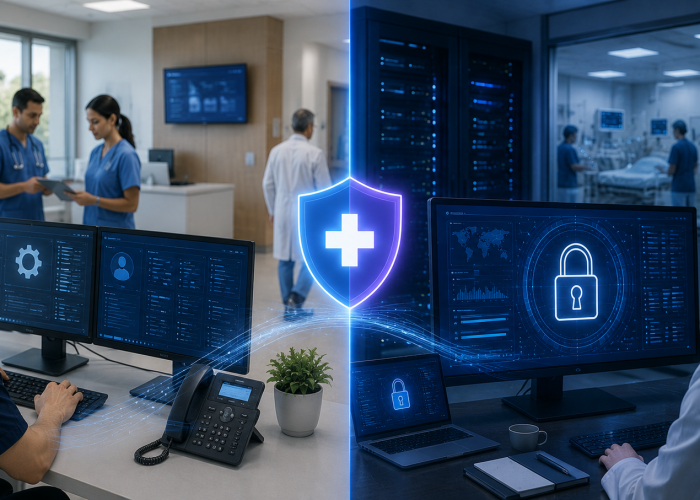
Healthcare IT support keeps clinics, physician practices, hospitals, and healthcare organizations running every day, but operational reliability alone does not guarantee cybersecurity. Many healthcare leaders confidently answer that they are protected because they already have an IT provider managing their technology. While that response is understandable, it often overlooks an important distinction between maintaining systems and actively defending them against modern cyber threats.
This misunderstanding has become increasingly common as healthcare organizations depend more heavily on digital infrastructure. Electronic Health Records (EHRs), cloud applications, telehealth platforms, medical devices, and remote access solutions all require reliable IT management to support patient care. However, the technologies that keep a clinic operational are not necessarily designed to identify hidden vulnerabilities before attackers exploit them.
The difference between IT operations and cybersecurity is becoming more significant every year. Cybercriminals no longer rely on obvious attacks that immediately disrupt systems. Instead, they quietly search for overlooked weaknesses, compromised credentials, outdated software, and insecure third-party connections that allow them to remain inside healthcare environments without detection.
Understanding this distinction allows healthcare organizations to build stronger security programs without replacing the IT teams they already trust. Operational IT and cybersecurity are complementary disciplines that work together to protect both technology and patient care.
Understanding the Role of Healthcare IT Support
Healthcare IT support focuses on keeping technology available, reliable, and functioning efficiently. IT professionals install hardware, maintain servers, configure workstations, manage software updates, troubleshoot user issues, and ensure clinical systems remain operational. Their work allows physicians, nurses, administrators, and billing teams to perform their daily responsibilities without unnecessary technical interruptions.
Most healthcare organizations depend heavily on their IT providers because technology touches nearly every aspect of patient care. Scheduling appointments, documenting clinical encounters, processing insurance claims, accessing diagnostic images, and communicating with patients all rely on stable technology. Without dependable IT support, even routine operations can become difficult.
These responsibilities are essential, but they answer a different question than cybersecurity. Operational support focuses on whether systems are working today, while cybersecurity asks whether those same systems can withstand an intentional attack tomorrow. Both objectives are critical, but they require different expertise, tools, and evaluation methods.
Why Cybersecurity Requires a Different Perspective
Cybersecurity assumes that attackers are actively searching for weaknesses rather than waiting for technology to fail naturally. Security professionals examine systems from an adversary’s perspective, identifying opportunities that malicious actors could exploit before legitimate users notice any problems. This proactive approach differs significantly from traditional IT maintenance.
A server may operate perfectly while still containing a critical software vulnerability. A firewall may appear to be functioning normally even though one insecure rule exposes internal services to the internet. Likewise, a cloud application may synchronize data without issue while using weak authentication that attackers could exploit.
Cybersecurity therefore measures risk rather than operational performance. The absence of outages, help desk tickets, or application failures does not automatically indicate that an organization is secure. Some of the most damaging healthcare breaches begin in environments that appeared completely healthy before the attack.
Healthcare Remains a Prime Target for Cybercriminals
Healthcare organizations consistently rank among the most frequently targeted sectors for ransomware, credential theft, and data breaches. Patient information holds significant value because it combines medical, financial, and personal data that cannot easily be replaced after exposure. Criminal groups understand this value and actively pursue healthcare organizations of every size.
Smaller physician practices and community clinics are not immune to these threats. Many attackers specifically target organizations with limited cybersecurity resources because they often have fewer security controls and smaller internal teams. The size of the organization rarely determines whether it becomes a target.
The consequences extend well beyond financial loss. Cyber incidents can delay patient care, interrupt diagnostic services, postpone surgeries, disrupt pharmacy operations, and force staff to return temporarily to manual documentation. These operational impacts demonstrate why cybersecurity has become a patient safety concern rather than simply an IT issue.
The Cost of Assuming Everything Is Covered
Healthcare executives often assume that cybersecurity responsibilities are automatically included within general IT support agreements. While many managed service providers implement valuable security controls, comprehensive cybersecurity typically requires additional specialized assessments and ongoing validation. Assuming complete protection without verification creates unnecessary risk.
Threat actors exploit weaknesses that remain invisible during normal IT operations. An exposed remote desktop service, an outdated VPN appliance, or an improperly configured cloud environment may continue operating normally for months while remaining vulnerable to attack. Without proactive security testing, those weaknesses often remain undiscovered until attackers identify them first.
Organizations should periodically review exactly which cybersecurity services are included in their technology support agreements. Understanding those boundaries helps leadership identify where additional expertise or independent security validation may be beneficial.
Where Traditional IT Support Can Leave Security Gaps
General IT support prioritizes availability, usability, and operational efficiency. Cybersecurity focuses on identifying weaknesses that attackers could leverage despite systems appearing healthy. This difference explains why organizations can have excellent IT support while still carrying significant cyber risk.
Common gaps include:
- Internet-facing vulnerabilities that have never been actively tested
- Firewalls with outdated or overly permissive security rules
- VPN appliances running unsupported firmware
- Administrative accounts with excessive privileges
- Cloud services lacking proper security configurations
- Vendor-managed systems receiving minimal oversight
- Connected medical devices outside routine security monitoring
None of these situations necessarily indicate poor IT performance. They simply illustrate areas where specialized cybersecurity reviews provide additional value.
Hidden Vulnerabilities Often Go Undetected
One of the most common findings during security assessments is the presence of vulnerabilities that have existed unnoticed for years. These weaknesses rarely cause visible operational problems, allowing organizations to assume everything is functioning securely. Unfortunately, attackers routinely search for exactly these types of overlooked exposures.
Externally accessible services are particularly attractive because they provide direct entry points into healthcare environments. Once attackers gain initial access, they often spend time gathering credentials, identifying sensitive systems, and expanding their access before launching ransomware or stealing information. Early detection dramatically reduces this risk.
Routine vulnerability assessments provide organizations with visibility into these hidden issues before they become security incidents. Rather than reacting after an attack, healthcare organizations can prioritize remediation based on actual exposure.
Backup Success Does Not Always Mean Recovery Success
Many healthcare organizations receive daily reports confirming that backups completed successfully. While these reports are valuable, they do not necessarily prove that data can be restored after ransomware or hardware failure. Backup verification and recovery testing are two different activities.
A successful backup may still fail during restoration because of corrupted files, incomplete configurations, missing encryption keys, or incompatible hardware. These issues often remain undiscovered until recovery is urgently needed. Waiting until after a cyberattack to discover restore failures significantly increases operational disruption.
Regular recovery testing provides confidence that critical clinical and administrative systems can actually be restored within acceptable timeframes. This testing should become part of every organization’s business continuity and disaster recovery planning.
Identity and Access Management Remains a Critical Challenge
User permissions naturally evolve as employees change departments, receive promotions, or assume temporary responsibilities. Without periodic reviews, staff members may accumulate administrative privileges far beyond what they currently require. Excessive permissions increase the potential damage resulting from compromised credentials.
Healthcare organizations should regularly evaluate who has access to sensitive applications, administrative tools, and infrastructure. Privileged accounts deserve additional monitoring because they provide broad visibility and control over organizational systems. Strong identity governance significantly limits attacker movement after an initial compromise.
Multi-factor authentication, unique administrative accounts, and least-privilege access models all reduce unnecessary exposure. These controls strengthen cybersecurity without disrupting everyday clinical operations.
Third-Party Vendors and Connected Medical Devices Expand Risk
Healthcare organizations depend on numerous external vendors to deliver specialized services and maintain clinical equipment. Imaging systems, infusion pumps, laboratory analyzers, patient monitoring platforms, cloud applications, and revenue cycle solutions frequently require remote connectivity. Every external connection expands the organization’s attack surface.
Many organizations carefully manage employee workstations while overlooking vendor-managed technologies. Responsibility for these systems may be shared among manufacturers, service providers, and internal IT staff, creating uncertainty regarding maintenance and security updates. Clear ownership is essential to avoid unmanaged infrastructure.
Organizations should document every internet-connected medical device and vendor relationship. Regular security reviews help ensure these systems remain aligned with organizational cybersecurity expectations and HIPAA requirements.
The Human Element Continues to Drive Healthcare Breaches
Technology alone cannot eliminate cybersecurity risk because people remain central to healthcare operations. Many successful attacks begin with phishing emails, fraudulent invoices, impersonation attempts, or convincing text messages that appear completely legitimate. Even experienced employees can occasionally make mistakes under pressure.
Security awareness training helps employees recognize suspicious communications before sensitive information is exposed. Staff should understand how to verify unusual requests, report suspected phishing attempts, and safely handle unexpected attachments or login prompts. Continuous education reinforces secure habits without overwhelming busy clinical teams.
Organizations that combine technical controls with workforce education develop stronger overall resilience. Employees become active participants in cybersecurity rather than simply end users of technology.
What Vulnerability Assessment and Penetration Testing Adds
Vulnerability Assessment and Penetration Testing (VAPT) provides independent validation that traditional IT support cannot fully deliver. Rather than assuming systems are secure, VAPT actively evaluates infrastructure using techniques similar to those employed by real attackers. This approach identifies weaknesses before they can be exploited.
A comprehensive VAPT engagement helps healthcare organizations:
- Identify exploitable vulnerabilities
- Validate existing security controls
- Prioritize remediation based on measurable risk
- Improve HIPAA Security Rule readiness
- Strengthen cyber insurance documentation
- Support regulatory and compliance reviews
- Reduce ransomware exposure
Annual testing, along with assessments following major technology changes, provides valuable insight into evolving organizational risk.
Cybersecurity Complements Healthcare IT Support
Investing in cybersecurity does not require replacing a trusted IT provider. Instead, cybersecurity adds independent validation that strengthens the work already being performed by operational IT teams. Both disciplines contribute different expertise toward the same organizational objective.
IT professionals maintain technology availability while cybersecurity specialists evaluate defensive effectiveness. Working together allows organizations to identify operational issues and security weaknesses without creating unnecessary duplication. Collaboration often produces better long-term outcomes than treating the two disciplines separately.
Healthcare leadership benefits when both teams share information and coordinate remediation efforts. Security findings become actionable improvements rather than isolated technical reports.
Final Thoughts
The question healthcare leaders should ask is no longer whether they have an IT provider. The more important question is whether their organization has independently validated that its systems can withstand today’s cyber threats. Maintaining technology and proving security are separate responsibilities, and both are essential for protecting patient care.
Healthcare IT support provides the operational foundation that every clinic depends on, while cybersecurity delivers the evidence needed to understand real organizational risk. Together, they create a stronger, more resilient healthcare environment capable of supporting both clinical operations and regulatory expectations.
To stay informed about healthcare cybersecurity trends, HIPAA compliance guidance, vulnerability management, penetration testing, and practical security strategies for clinics and healthcare organizations, follow Tempest Healthcare IT on LinkedIn: https://www.linkedin.com/company/tempesthealthcareit